04 — C: the controller, trained inside a dream
How a policy was learned without ever touching the real game during training, how well it plays the real game, and what that tells us about the world model.
1. The idea in one sentence
If M is a good enough simulator of the game, we can train an agent inside M — millions of imagined frames, no renderer, no physics — and then drop the agent into the real game and see whether what it learned transfers.
That transfer is the acid test of the whole world model. A dream that looks plausible but is wrong in the ways that matter for the task will produce an agent that is confident and useless. A dream that captures the task-relevant physics will produce an agent that works on the first real try.
2. The task and the yardsticks
Objective: maximise paddle contacts in a 200-step episode. The ball never “dies” in this environment, so this is purely a tracking task: be under the ball when it arrives.
Before any learning, three reference points from
wm/eval_controller.py, each on 100 identical
episodes:
| policy | what it is | contacts / episode |
|---|---|---|
| stay | never move | 0.92 |
| random | sticky random actions (the data-collection policy) | 0.93 |
| oracle | moves toward the true ball_x using privileged state |
1.68 |
Two things to absorb before reading any result. First, the ball only comes down about 1.7 times per episode, so 1.7 is the ceiling; the oracle is essentially at it. Second, the paddle is 26% of the box wide, so “do nothing” already catches half the balls. Beating random is a very low bar here; the oracle is the number to compare against.
We also count interceptions: runs of consecutive contact frames collapsed to one. Contact is a per-frame flag, and a policy that pins the ball against the paddle can register several “hits” per approach. This turned out to matter (§6.3).
3. The controller
Code: wm/controller.py.
Following the paper, C is as small as it can be: one linear layer,
action = argmax( W · [z_t, h_t] + b ) W: 3 × 272, b: 3 → 819 parameters
z_t is V’s code for the current frame (16 numbers) and h_t is M’s hidden
state (256 numbers), both standardised with statistics computed once on
training data. No hidden layer, no nonlinearity.
Why so small? Two reasons that reinforce each other. A tiny policy can be
trained by a black-box evolutionary optimiser that needs no gradients — so
it does not matter that the dream is sampled, or that the real environment is
not differentiable. And a tiny policy cannot memorise much, so whatever
“intelligence” it displays must already be present in its inputs: in z and
above all in h. The controller is a probe of the world model as much as it is
an agent.
Which inputs? We trained variants on [z, h] (the paper’s choice) and on
z alone. Doc 03 showed z has no velocity; a controller that only sees z
knows where the ball is but not where it is going. The paper’s claim is
that C needs h. We test it.
Timing. There is a subtlety that is easy to get wrong and that would
silently break transfer. M was trained to consume (z_t, a_t) and produce the
state that predicts z_{t+1} — but the controller has to choose a_t before
that state exists. So C acts on [z_t, h_t^{pre}], where h^{pre} is the
hidden state left over after processing (z_{t-1}, a_{t-1}): current
observation plus carried-in history. Then (z_t, a_t) goes into M and the
cycle repeats. The dream loop and the real-environment loop implement this
identically, and a unit test drives both with the same latent sequence and
asserts the controller sees the same inputs to 1e-6. If they disagreed, C would
be reading a differently-shifted signal at test time than it trained on.
4. The dream as an environment
Code: wm/dream_env.py.
DreamEnv wraps M as a batched gym-like environment: reset() returns
[z, h], step(actions) returns the next [z, h], a reward, and the predicted
contact probability. It runs 512 episodes in parallel on the CPU faster than the
real simulator runs one.
Three decisions worth knowing:
- Warm starts. A dream starts at a real
(episode, time)drawn from the training data, with M warm-started on the 8 true frames before it. Starting fromh = 0would mean M does not know the ball’s velocity and the first dozen dreamed frames are wrong. - The reward is predicted, not measured. There is no simulator inside the
dream. “Reward” means M’s reward head (
1 − |ball_x − paddle_x|, dense) or M’s contact head (sparse), evaluated on M’s own dreamed latents. This is the gamble of the method: if a head is wrong in some exploitable direction, the optimiser will find it — finding exploitable directions is what optimisers do. - Temperature. The paper raises the sampling temperature above 1 so the dream is too uncertain to exploit. We trained at τ = 1.0 (default) and 1.5.
5. Training with CMA-ES
Code: wm/train_controller.py.
CMA-ES maintains a Gaussian over the 819 parameters; each generation it samples a population of 32 candidates, scores each by its mean return over 16 dreams of 150 steps, and moves the Gaussian toward the better ones. All candidates in a generation see the same 16 start states (common random numbers), so the ranking is paired and much less noisy. 200 generations take about 11 minutes.
python -m wm.train_controller --out runs/ctrl_v1 --inputs zh --reward mix \
    --temperature 1.0 --popsize 32 --rollouts 16 --dream-steps 150 --generations 200 \
    --real-eval-every 5 --real-eval-episodes 24
Every 5 generations, the current best candidate is also dropped into the real game for 24 episodes and its contact count logged. These real episodes are not used for training the parameters — CMA-ES never sees them — but they are used in one of two ways to pick which parameters to keep, and we report both:
params_last_dream: the final CMA-ES mean. What the dream alone would have chosen. Zero real episodes consulted.params_best_real: the candidate that scored best on the periodic real check. A light form of model selection on real data.
Variants trained (all identical except the flag named):
| run | inputs | reward | τ | trained in |
|---|---|---|---|---|
ctrl_v1 |
z + h | mix (contact + 0.1·dense) | 1.0 | dream |
ctrl_dense |
z + h | dense only | 1.0 | dream |
ctrl_z_only |
z only | mix | 1.0 | dream |
ctrl_tau1.5 |
z + h | mix | 1.5 | dream |
ctrl_real |
z + h | true contacts | — | the real game (same CMA-ES) |
6. Results
6.1 The headline table
Real game, 200-step episodes. Two independent evaluations are shown: the agent’s own on 100 episodes (seeds 5000+), and a re-check I ran afterwards on 60 fresh episodes (seeds 9000+) to see how much was seed luck. Contacts per episode, with interceptions in parentheses.
| controller | seeds 5000+ (100 eps) | seeds 9000+ (60 eps) |
|---|---|---|
| stay | 0.92 (0.92) | 0.93 (0.93) |
| random | 0.93 (0.76) | 0.73 (0.67) |
| oracle (true state) | 1.68 (1.63) | 1.60 (1.55) |
ctrl_v1, selected on real check |
1.44 (1.43) | 1.55 (1.47) |
ctrl_v1, dream-only selection |
1.45 (1.31) | 1.68 (1.38) |
ctrl_dense, selected on real check |
1.98 (1.61) | 2.12 (1.48) |
ctrl_dense, dream-only selection |
1.47 (1.40) | 1.25 (1.20) |
ctrl_z_only |
1.20 (1.03) | 0.97 (0.93) |
ctrl_tau1.5 |
1.26 (1.17) | — |
ctrl_real (no world model) |
2.00 (1.27) | 1.40 (1.12) |
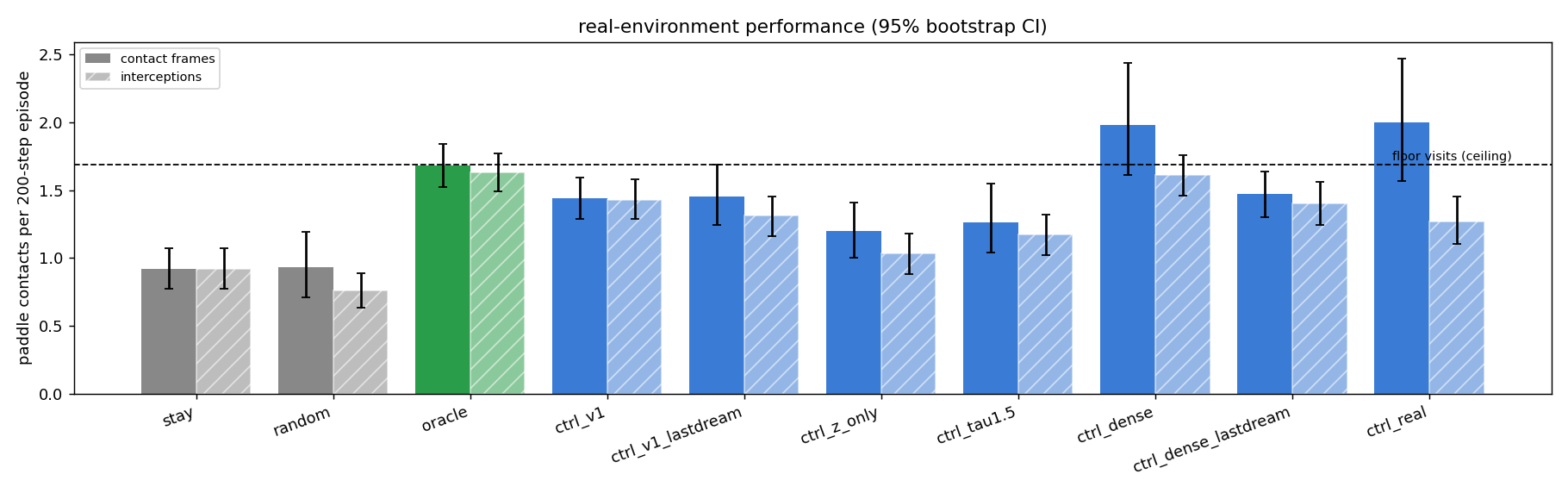
Confidence intervals are wide (±0.15 to ±0.4), so read the pattern, not the second decimal. The pattern is stable across both evaluations:
- A controller trained on zero real frames plays the real game at
85–90% of the oracle.
ctrl_v1intercepts the ball 1.4–1.5 times per episode against the oracle’s 1.55–1.63 and stay’s 0.93. Its mean paddle-ball gap at the moment the ball reaches the floor is 0.11 of the box, versus 0.06 for the oracle and 0.24–0.29 for the trivial policies. It is tracking, not getting lucky. - Remove
hand the controller collapses to the do-nothing baseline.ctrl_z_onlyscores 0.93–1.03 interceptions — indistinguishable fromstay. This is the paper’s central claim reproduced: a policy on the frame code alone cannot anticipate, because the frame code has no velocity. - Training in the real game with the same optimiser was not better.
ctrl_realused 1,024,000 real environment steps; the dream-trained controllers used 0. On fresh seeds it scored 1.40 (1.12 interceptions) — belowctrl_v1. Its 2.00 on the first evaluation was a combination of seed luck and a metric loophole (§6.3). It was also given a smaller population to fit a time budget, so this is not a perfectly fair race; but the direction is clear and the cost gap is enormous (§6.5).
6.2 Does the controller actually move the right way?
Contact counts are noisy, so the agent added a sharper, decision-level diagnostic: at each frame where the ball is descending in the lower half of the box, does C’s preferred direction agree with the direction to the ball? Chance is 0.50.
| controller | agreement (seeds 5000+) | agreement (seeds 9000+) |
|---|---|---|
ctrl_dense |
0.70 | 0.70 |
ctrl_v1 |
0.60 | 0.59 |
ctrl_z_only |
0.53 | 0.51 |
ctrl_real |
0.49 | 0.47 |
This is the most robust table in stage three — it barely moves between seed
sets — and it says three things plainly. The dense-reward controller moves the
right way 70% of the time on the frames that matter. The z-only controller is
at chance, as predicted. And the real-trained controller is at chance too: its
high contact count on the first evaluation came from something other than
tracking.
A regression of ctrl_v1’s decisions on true state variables finds the
largest coefficient on the paddle’s own velocity: the controller commits to a
sweep rather than re-deciding every frame — sensible for a bang-bang actuator
that needs ~30 frames to cross the box. We found no evidence that any
controller leads the ball (agreement with the ballistic landing point is never
higher than with the ball’s current position). With a paddle that crosses the
box in 30 frames and a ball whose remaining fall is usually shorter, following
and leading rarely prescribe different actions, so this is unsurprising.
6.3 A metric loophole, found by optimisation
ctrl_real beat the oracle on raw contacts in the first evaluation
(2.00 vs 1.68). A learned policy exceeding a privileged-state oracle is a red
flag, and chasing it produced the interceptions column: ctrl_real registers
1.27 interceptions per episode — fewer than ctrl_v1 — but several contact
frames per interception. It learned to catch the ball in a way that keeps it
in contact for multiple frames rather than to catch it more often. Optimising
the raw per-frame contact flag in the real environment found the slack in the
metric. Optimising M’s dense head did not, because 1 − |ball_x − paddle_x|
has no such slack.
General lesson: when a learned policy outperforms an oracle, suspect the metric before celebrating.
6.4 Does the dream transfer? — watching the two curves
Every training run logs the dream return alongside the periodic real score. Whether those two curves move together is the direct measurement of “is the world model good enough to train in”.
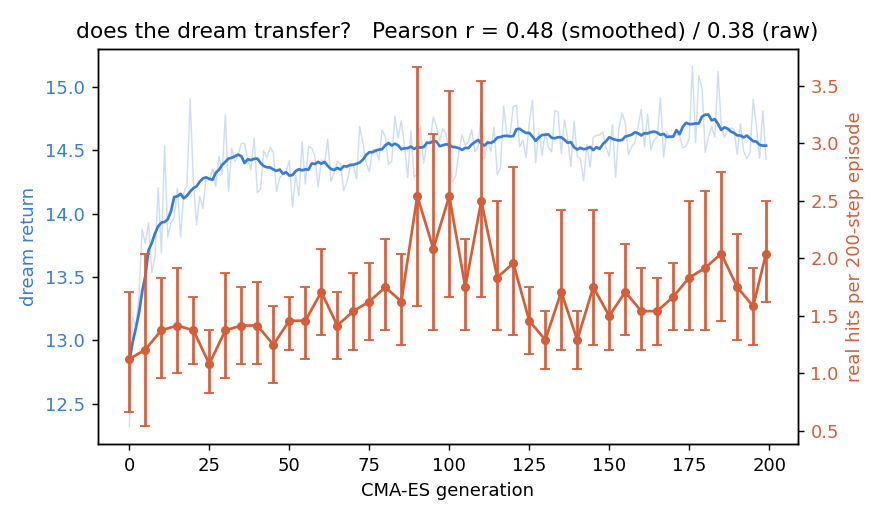
ctrl_v1: yes. Both curves rise together (r ≈ 0.5 after smoothing the
dream curve’s per-generation jitter). Real contacts climb from 1.1 to about 2.0
per episode on the 24-episode check while the dream return climbs from 12.3 to
14.4.
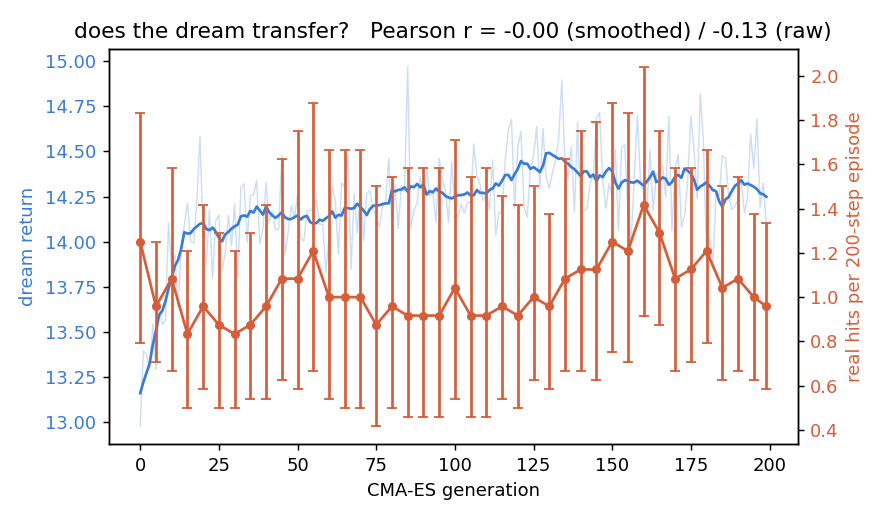
ctrl_z_only: the textbook failure. Its dream return rises just as
smoothly as ctrl_v1’s — CMA-ES is making steady progress against M’s reward
heads — while its real score drifts down over the first 50 generations
(r = −0.5). Using a representation that cannot support the task, the only
progress available was progress against the model’s imperfections. If you
only had the fitness curve, you would call this run a success. This single
figure is the best argument in the project for never trusting a dream without a
real-world check.
ctrl_dense’s dream return saturates by generation 25 and then barely moves,
so its correlation coefficient is computed on noise and is meaningless (≈ 0);
its real score kept creeping up regardless. ctrl_tau1.5 had the highest
correlation (0.67) and the lowest score of the [z, h] runs: raising the
temperature did make the dream harder to exploit, but at this budget
exploitation was not the binding constraint, and the noisier dream mostly made
the useful directions harder to find. The paper’s τ > 1 prescription is a
trade-off, not a free lunch.
6.5 The point of the exercise: sample cost
| dream steps | real steps used for training | real steps for the diagnostic curve | |
|---|---|---|---|
| each dream-trained run | 15,360,000 | 0 | 196,800 |
ctrl_real |
0 | 1,024,000 | 43,200 |
For ctrl_v1 the diagnostic real steps bought nothing but the plot: the
dream-only parameters score the same as the real-selected ones (1.45 vs 1.44,
and 1.68 vs 1.55 on fresh seeds). Dropping the periodic check makes it a
1,067,200 : 0 comparison in real environment steps, for a controller that plays
at least as well. For ctrl_dense the check did earn something — the
real-selected parameters beat the dream-only ones by 0.5–0.9 contacts — so
there the honest description is “a paid-for model-selection step”.
Wall clock tells the same story: one dream generation (76,800 batched RNN steps) takes 1.3 s; one real generation (25,600 frames, each rendered, encoded and stepped) takes 24 s.
6.6 Watching it play
runs/ctrl_eval/real_play_ctrl_v1.gif— the dream-trained controller in the real game. The paddle visibly sweeps under the descending ball.runs/ctrl_eval/dream_play_ctrl_v1.gif— the same controller inside M’s imagination, decoded by V. The dream stays coherent for all 200 steps: a crisp ball, a crisp paddle, plausible bounces. The border turns green when M’s contact head fires, and it fires exactly on the frames where the ball sits on the paddle. (Cherry-picked: the most contact-rich of 16 dreams, since contacts are <1% of frames and a random dream usually shows none.)runs/ctrl_eval/real_vs_dream_side_by_side.gif— the same 8 real frames warm up both branches, then the real game (left) and the dream (right) run under the same controller. They diverge within ~30 frames, and the dream stays internally coherent while doing so. That is precisely the regime in which a dream-trained controller can still transfer: it learned a reflex, not a trajectory. The dream does not need to predict this episode; it needs to get the local rule “ball coming down here → move there” right.
7. What was achieved, and what to remember
Achieved. An 819-parameter policy trained entirely inside a learned model of the game, on zero real frames, that plays the real game at 85–90% of a privileged-state oracle and matches or beats a policy trained on a million real frames. And a clean negative control: the same procedure without the recurrent state produces a policy no better than standing still, while its dream score climbs just as happily.
Remember.
- The controller is a probe of the world model: with 819 parameters, any
competence it shows must come from
[z, h]. Thathis necessary and sufficient for near-oracle play is the practical confirmation of doc 03’s “velocity lives in h”. - Always plot dream return against real return. A rising dream curve with a flat or falling real curve is exploitation, and it looks exactly like success from the inside.
- Prefer a dense, un-gameable reward head (
1 − |ball_x − paddle_x|) over a sparse, over-confident one (the class-reweighted contact head). Themixreward was measurably worse thandense. - When a policy beats an oracle, check the metric. Count interceptions, not contact frames.
- Report the selection procedure with the number. “Best of 40 real checks” and “final CMA-ES mean” are different claims with different sample costs.
- Confidence intervals of ±0.3 contacts on 100 episodes mean the ranking of the top three controllers is not settled. The decision-level agreement statistic (§6.2) is far more stable and should be the primary metric next time.
Open threads. A fair ctrl_real with the full population; more real
evaluation episodes (the harness is fast); a controller with one hidden layer to
see whether the linear one is the bottleneck; and — the natural v1.1 — iterate:
collect data with the trained controller, retrain M on it, retrain C, and see
whether the useful dream horizon and the transfer both improve.