v3.1 — 08: The controller. Does memory buy play?
The dream is dead and the controllers beat the memoryless bound anyway. Both halves of that sentence are the result.
Full numbers, commands and caveats: wm/README_C31.md.
1. The premise, checked first this time
v3’s lesson was that the memoryless bound must be measured before anything is trained. v3.1’s is the next one along: the dream must be measured before anything is trained inside it.
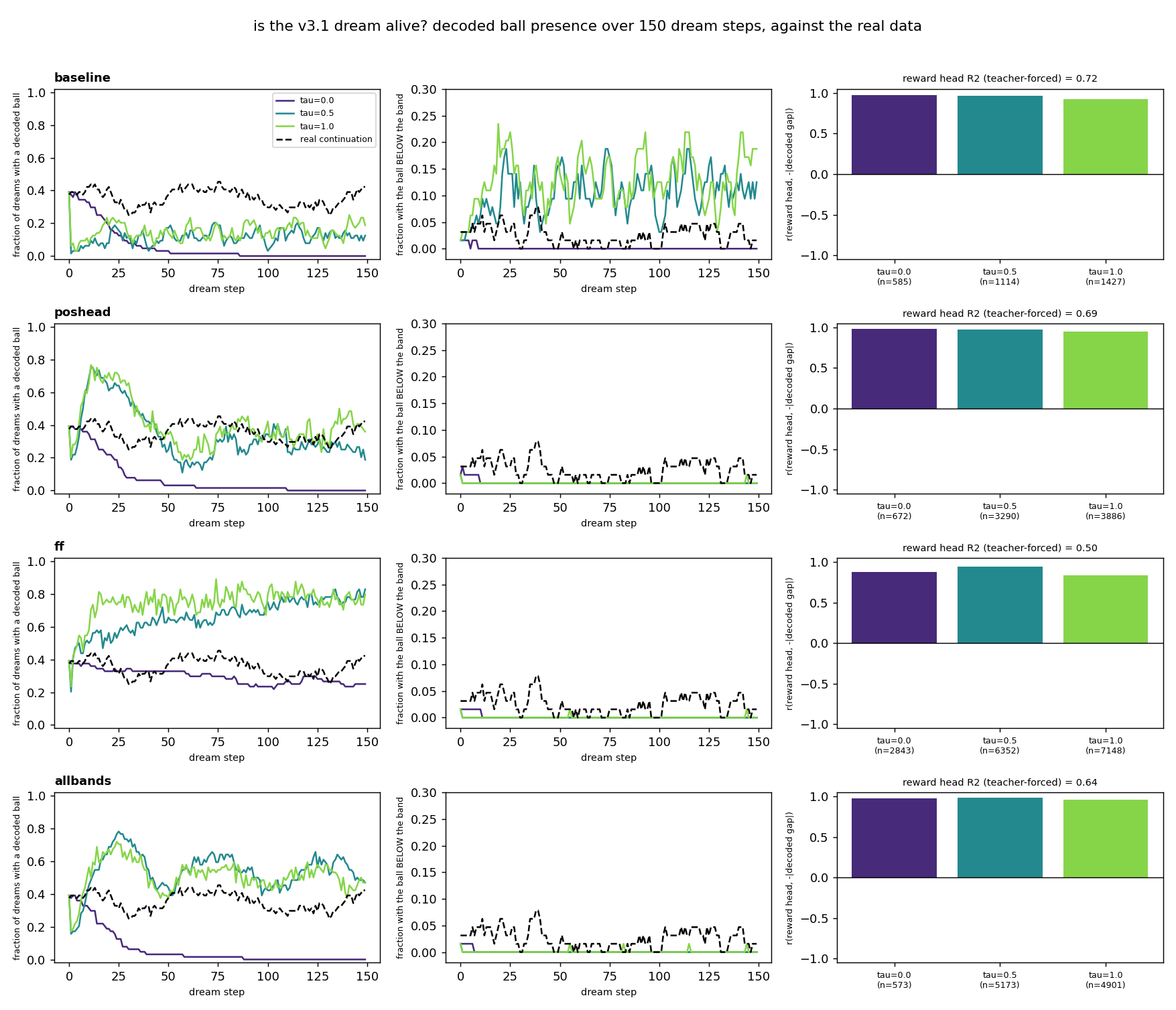
wm.eval_dream_alive dreams 150 steps from 64 real starts, decodes every frame,
and counts balls — against the real continuation of the same 64 starts, frame
for frame. Four dynamics models × three temperatures, 102 seconds.
| ball present | ball below the band | arrivals below the band / 150 frames | |
|---|---|---|---|
| the real world | 35.5 % | 2.5 % | 0.80 |
rnn_v31 (fair), τ=0 |
6.1 % | 0.1 % | 0.03 |
rnn_v31_poshead, τ=1 |
40.5 % | 0.0 % | 0.03 |
rnn_v31_ff (floor), τ=1 |
74.5 % | 0.0 % | 0.05 |
rnn_v31_allbands, τ=1 |
51.1 % | 0.1 % | 0.08 |
The dream is not a world for this task. And the way it fails is the thing to take away: three of the four models paint a ball on 40–75 % of their frames — as many as the world, or twice as many — and every one of those balls is above the band, near the top of the box, where the paddle cannot reach it and no action changes it. A presence-only criterion, which is what v3 used (“the ball is there on 36 % of frames”), would have called these dreams healthy. The statistic that separates a world from a picture of one is arrivals in the region where the agent can act, and on that every model is at 4–10 % of the world’s rate.
The one exception proves the same point. The fair model at τ ≥ 0.5 does put a ball below the band — 4 to 6 times more often than the world does, with a decoded height that barely varies. It has collapsed the ball onto the band’s lower edge and is flickering across the detector’s threshold. More arrivals than the world is not a more alive dream.
2. And yet: five of seven controllers beat the memoryless bound
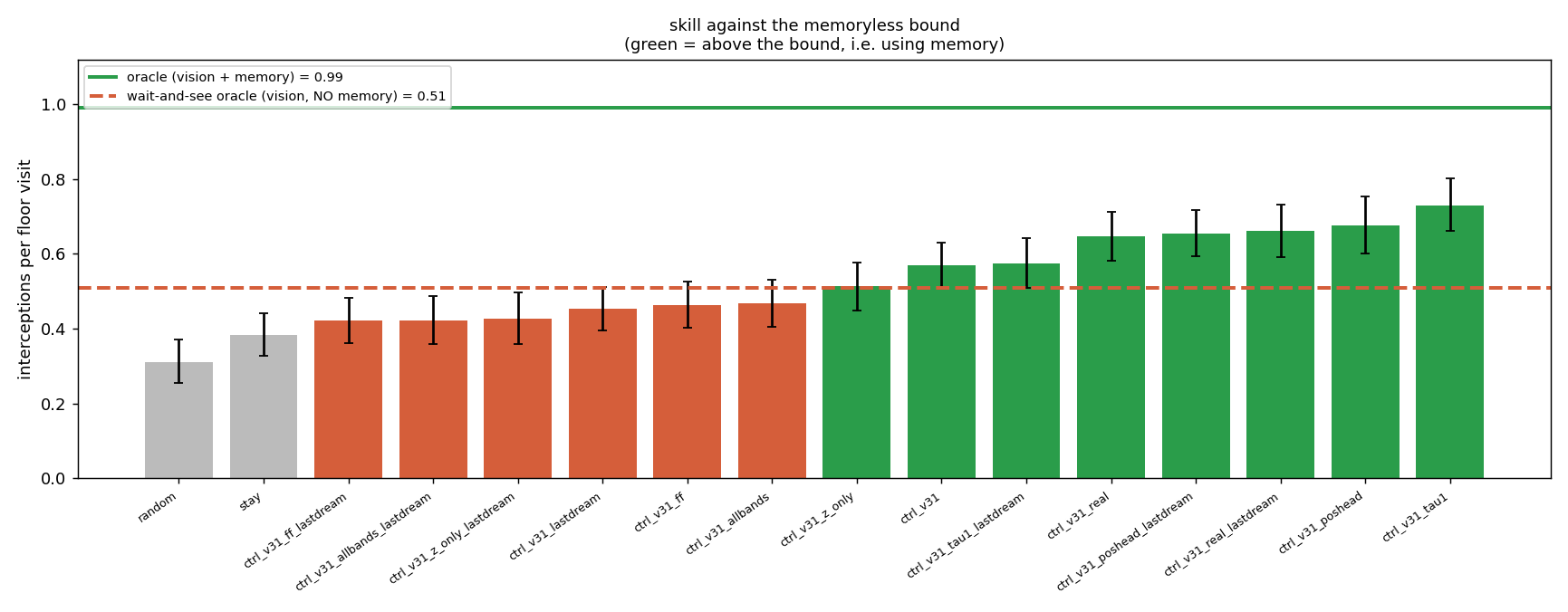
Seven controllers, 150 evaluation episodes, band (0.13, 0.63), paddle 0.16.
| policy | interceptions / floor visit | short move | medium | long (>0.35) |
|---|---|---|---|---|
oracle (vision + memory) |
0.99 | 1.00 | 1.00 | 0.97 |
ctrl_v31_tau1 (fair, τ=1) |
0.73 | 0.76 | 0.71 | 0.72 |
ctrl_v31_poshead (privileged) |
0.68 | 0.76 | 0.59 | 0.71 |
ctrl_v31_real (1.07 M real steps) |
0.65 | 0.86 | 0.80 | 0.37 |
ctrl_v31 (fair, τ=0) |
0.57 | 0.67 | 0.56 | 0.45 |
ctrl_v31_z_only (no memory, control) |
0.51 | 0.92 | 0.45 | 0.11 |
wait_and_see (vision, no memory) |
0.51 | 1.00 | 0.57 | 0.04 |
ctrl_v31_ff (feed-forward floor) |
0.46 | 0.85 | 0.27 | 0.20 |
stay |
0.38 | 0.99 | 0.13 | 0.00 |
(An independent re-check by the orchestrator on 90 fresh episodes, seeds
9000+, gives the same ordering: fair τ=1 0.73, privileged 0.70, memoryless
bound 0.53, z-only control 0.47, feed-forward floor 0.40, oracle 0.98 —
runs/ctrl_eval_v31/recheck_seed9000.md.)
The best fair controller is +0.22 above the memoryless bound with
non-overlapping intervals, closing 46 % of the bound-to-oracle gap — and it is
flat across the required-move split (0.76 / 0.71 / 0.72) in a bin where a
policy with perfect vision and zero memory scores 0.04. That flatness is the
object-permanence signature the design asked for, and it is the first time in
this project that it has been observable at all: on v3’s band wait_and_see was
1.00 / 1.00 / 0.97 and the split measured nothing.
The negative control fired the right way, too — and there is a matched one.
ctrl_v31_z_only_tau1 has the same V, the same M, the same training temperature
and the same optimiser as the 0.73 row, and differs only in that h is removed
from its inputs, which makes knowing anything about a hidden ball impossible by
construction. It scores 0.51 — exactly the memoryless bound — and 0.06 on
long moves. The 0.22 is h. (In v3 this control won the long bin and
destroyed the interpretation.)
And the paddle now moves in the dark. The fair controller is in motion on 52 % of hidden frames (v3: 13 %), moves toward the landing point on 63 % of those, and covers 28 % of the required move while blind (v3: 3 %) against the oracle’s 79 %. On the long band it covers 49 %: the longer it cannot see, the more of the journey it makes anyway.
3. So what is the dream doing?
It is a feature-conditioned reward model, not a simulator.
M’s dense reward head reads the true 1 − |ball_x − paddle_x| at R² 0.72 on
real latents, and inside the dream its output tracks the decoded ball-paddle
gap at r = 0.92–0.98. Meanwhile h carries the hidden ball’s horizontal
position at R² 0.52 (doc 07). So CMA-ES can discover “move toward where h says
the ball is” without ever having seen a dreamed ball come out of the band —
which is exactly what the numbers in §2 say it discovered. Doc 07 §4 anticipated
this (“the reward head may still be informative even when the decoded frame
shows no ball”); it is now measured rather than hoped.
Calling this “training in a world model” would overclaim. The rollout supplies the state sequence; the head supplies the objective; the part that would make it a world — a ball that goes behind an occluder and comes out the other side — is the part that does not work.
4. The three controls, and what each one settled
The privileged ceiling did not beat the fair model (0.68 vs 0.73, intervals
overlapping) and collapsed off its training band (0.30 and 0.16 on the short
and long bands, below the feed-forward floor, where the fair controller is flat
at 0.55 / 0.57 / 0.56). This is the third version of this project in which
supervising the hidden position explicitly buys nothing for play. On v3.1 there
is finally a clean reason: doc 07 showed the fair model’s hidden-x memory had
already caught up with the privileged model’s (R² 0.52 vs 0.48), so there was
nothing left to add — and what the position head did add did not generalise.
The real-trained controller did not beat them either (0.65). Same policy class, same inputs, 1.07 M real environment steps — 5.4× any dream run’s — and fitness measured as real interceptions. Its shape gives it away: 0.80 on medium moves, the best in the table, and 0.37 on long ones. Direct optimisation of a sparse outcome finds the best reaction policy and overfits its seed block (its real score peaks at generation 20 of 40 and then declines). What the dream supplies that real rollouts do not is a dense reward at every step — the signal that pays for moving while blind.
The feed-forward floor is a real floor (0.46, below the bound), and the gap from it to 0.73 is the largest effect in the table.
5. The honest failures
- The temperature chosen in advance was the wrong one. The selection rule picked τ = 0 for the fair model because its τ ≥ 0.5 dream over-arrives. Skill turns out to be monotone in the training temperature — 0.57 / 0.61 / 0.73 for τ = 0 / 0.5 / 1.0 — i.e. exactly the opposite of the ranking. The rule was applied honestly and before training, and it lost.
- One seed per row. The 0.73-vs-0.68 fair-vs-privileged ordering is well inside what a second CMA-ES seed could move.
- No causal test that the controllers read
h’s hidden-xspecifically; the behavioural controls (z_only,ff) are the whole argument. - The required-move bins are policy-dependent — measured from each policy’s own paddle — so within-bin comparisons are between different visit sets.
- The long bin rewards late arrival as well as early commitment. A floor
visit lasts about six frames, in which the paddle can cross more than its own
width, so a wandering policy can win long-bin visits without committing: one
z-only parameter set scores 0.43 there while covering 2 % of the required move while blind. The displacement column of the paddle-motion table is the statistic immune to this, and it is where the behavioural claim actually lives. - The measured bound is 0.51, not the design sweep’s 0.48; the sweep used 60 episodes and this uses the same 150 as every row it is compared to.
6. Lessons
- Measure the environment before training in it — including the one you built. v3’s lesson was “measure the memoryless bound”; v3.1’s is “measure the dream”. Both cost minutes and both change what every later number means.
- “Is the object there” is not “is the object where the agent can act”. A dream can be 75 % full of balls and contain no reachable ball at all.
- A world model can be useful while being a bad world. What transferred here was a dense objective computed on a memory-carrying state, not a simulation. That is a weaker claim than the method usually makes and it is the one the evidence supports.
- Negative controls are worth more than ceilings.
z_onlysettled the interpretation of this stage; the privileged ceiling has now failed to be informative three times running.