v3.1 stage three (“C”) — the controller in a world that needs memory
Technical log. Hardware: Apple M1, 8 GB, CPU. Interpreter
python, every command from the repo root. The v3.1
VAE (runs/vae_v31/vae.pt) and all five v3.1 dynamics checkpoints were frozen
and no dataset was modified. Read docs/v3/06_v31_design.md
and README_V31.md §5 first — they establish the world, the
checkpoints, and the three numbers this stage is graded against.
The question v3 could not ask. v3’s band left the memoryless bound at 0.99
of the oracle, so its controller stage measured reaction speed and called it
permanence (README_C3.md). v3.1 drops the band’s bottom edge
to contact height and narrows the paddle, which takes the bound to 0.51 here
(0.48 in the design sweep’s 60 episodes) against an oracle’s 0.99. There is
now 0.48 of headroom, and the only question is whether anything reaches into it.
0. First: is the dream alive? (and it is not)
runs/rnn_v31_dream_alive/ — summary.md,
dream_alive.png, 102 s.
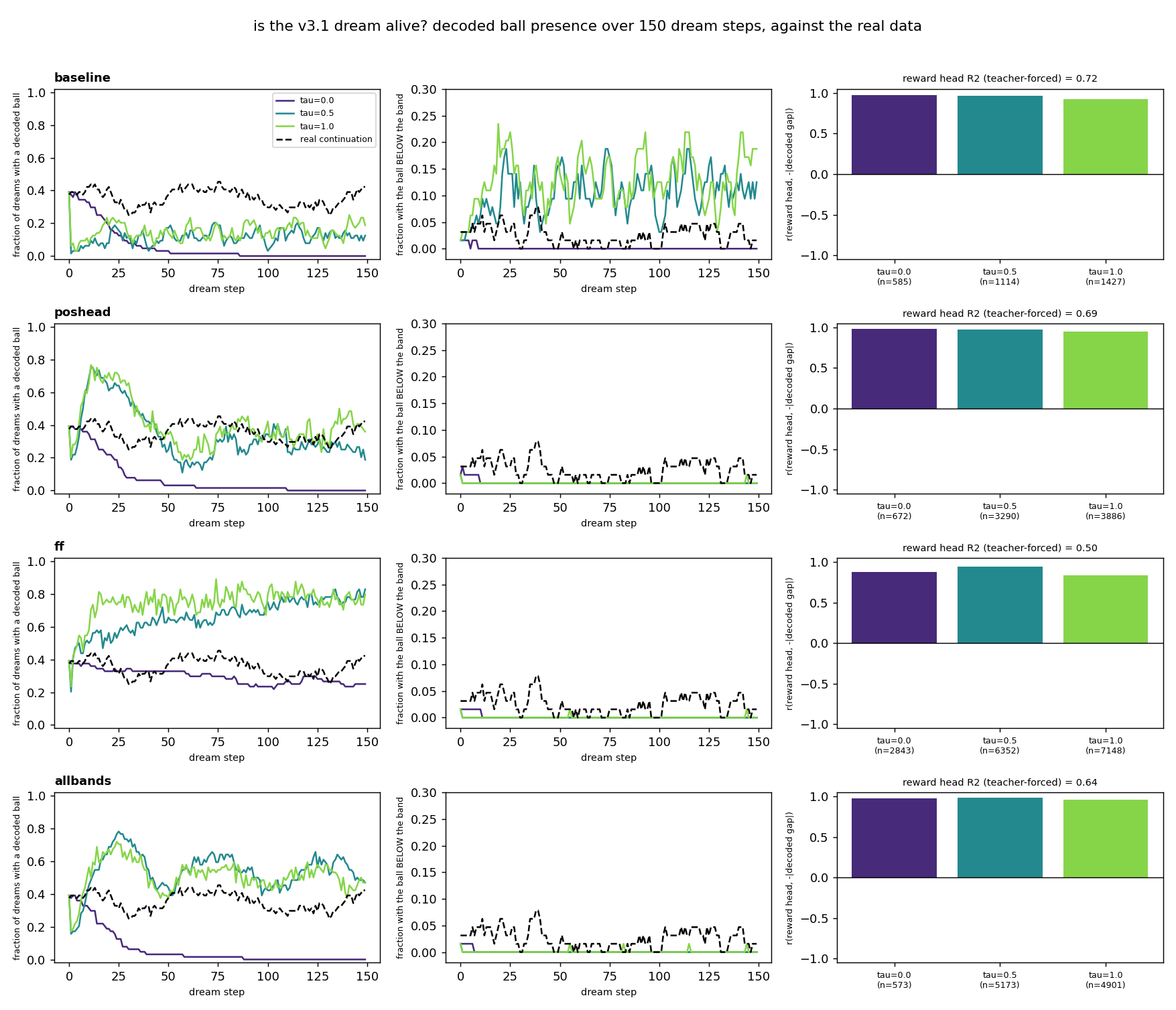
v3 trained six controllers and then found that the dreamed ball was present on 36 % of frames. v3.1 asks first. 64 dreams × 150 steps per cell, warm-started on 8 real frames, driven by one fixed sticky-random action stream, for each of four dynamics models × τ ∈ {0, 0.5, 1.0} — and graded against the real continuation of the same 64 starts, frame for frame.
THE v3.1 DREAM IS NOT A USABLE TRAINING ENVIRONMENT FOR THIS TASK. At its chosen temperature no model puts a ball below the band at a rate comparable to the world’s. The world arrives below the band 0.80 times per 150 frames; the four models manage 0.03 / 0.03 / 0.05 / 0.08.
| reference (real) | ball present | ball below the band | arrivals / 150 frames | ball-height sd |
|---|---|---|---|---|
4096 random train_mix frames |
35.7 % | 2.4 % | — | — |
| the dreams’ own 64 starts, continued for real | 35.5 % | 2.5 % | 0.80 | 0.164 |
| model | τ | ball present | ball below band | arrivals / run | height sd | mean decoded y | r(reward head, −|decoded gap|) |
|---|---|---|---|---|---|---|---|
baseline ← chosen τ=0 |
0.0 | 6.1 % | 0.1 % | 0.03 | 0.053 | 0.762 | 0.97 |
baseline |
0.5 | 11.6 % | 10.4 % | 3.62 | 0.059 | 0.121 | 0.96 |
baseline |
1.0 | 14.9 % | 12.8 % | 4.78 | 0.116 | 0.140 | 0.92 |
poshead ← chosen τ=0 |
0.0 | 7.0 % | 0.1 % | 0.03 | 0.053 | 0.758 | 0.98 |
poshead |
1.0 | 40.5 % | 0.0 % | 0.03 | 0.066 | 0.742 | 0.95 |
ff |
0.0 | 29.6 % | 0.1 % | 0.02 | 0.027 | 0.781 | 0.88 |
ff ← chosen τ=1 |
1.0 | 74.5 % | 0.0 % | 0.05 | 0.057 | 0.766 | 0.83 |
allbands |
0.5 | 53.9 % | 0.0 % | 0.02 | 0.065 | 0.774 | 0.98 |
allbands ← chosen τ=1 |
1.0 | 51.1 % | 0.1 % | 0.08 | 0.069 | 0.769 | 0.96 |
(the τ=0.5 rows for poshead and ff are in summary.md; they change nothing)
Four things to read off it, in order of how much they change the rest of this document.
1. “Is there a ball” is the wrong question, and a presence-only criterion
would have called three of these dreams healthy. ff paints a ball on
74.5 % of its frames — twice the real rate — and every one of them is parked
near the top of the box (mean decoded y 0.77, against a band that ends at 0.63).
A ball above the band is scenery: the paddle cannot reach it and no action
changes it. The statistic that matters is arrivals below the band, and on
that every model is at 4–10 % of the world’s rate.
2. The one dream that does drop a ball below the band does not drop a trajectory. The baseline at τ ≥ 0.5 arrives 3.6–4.8 times per 150 frames against the world’s 0.80 — four to six times too often — with a decoded height sd of 0.06–0.12 against the world’s 0.16 and a mean decoded y of 0.12. It is not playing catch; it has collapsed the ball onto the band’s lower edge and is flickering across the detector’s threshold. More arrivals than the world is not a more alive dream, which is why the selection rule is “closest to”, not “most”.
3. The reward head is honest anyway, and that is the mechanism for
everything below. Teacher-forced on real latents the dense head reads the true
1 − |ball_x − paddle_x| at R² 0.72 / 0.69 / 0.50 / 0.64; and inside the
dream, over the frames where a ball is decoded, its output correlates with the
decoded ball-paddle gap at r = 0.83–0.98. So CMA-ES is not optimising noise.
It is optimising a faithful tracking signal computed on latents whose ball is
above the band or absent. docs/v3/07
§4 predicted exactly this (“the reward head — trained on h, where x lives —
may still be informative even when the decoded frame shows no ball”); it is
measured here.
4. Two measurement bugs, both found by the pairing. The real reference was
first computed by walking frames.npy forward from each start and clamping at
the episode end, which turned half the reference windows into a repeated final
frame and put the real re-emergence rate at 48.8 % instead of 70 %. And the
first selection rule — “the τ whose re-emergence is closest to real” — is a
once-per-run indicator with 2.5-point resolution, and it picked τ = 0 (a dream
that never returns the ball) over τ = 0.5 (one that always does) by 0.1 of a
percentage point. Both are fixed and both are pinned by tests.
Chosen training temperatures: baseline 0.0, poshead 0.0,
ff 1.0, allbands 1.0. Because the baseline’s is not 1.0,
ctrl_v31_tau1 was trained at 1.0 as well — and, as §3 shows, it is the best
controller in the project.
How to read everything below. The controllers are fitted to a reward head evaluated on latents that contain no reachable ball. Whatever they learn, they did not learn it by watching a dreamed interception, because there were none.
1. Files added or changed
| file | what |
|---|---|
wm/eval_dream_alive.py |
new, 865 lines. The pixel ball/paddle detectors, the paired real reference, the reward-head checks, the temperature selection rule, the verdict and the figure |
wm/analyze_v3.py |
ball_mass gained a color argument (None = the ball, every existing caller). The same projection-with-residual-rejection finds the paddle, which the reward correlation needs |
wm/eval_controller_v3.py |
generalised from “v3’s world” to “a world named on the CLI”: --occluder-y, --paddle-w, --ball-radius, --dream-temperature, and one env dict that every rollout in the file — in-distribution, other-band, and both GIFs — is driven from. v3’s invocation with no new flags still builds v3’s world. New figure plot_skill_vs_bound; new headline table; the GIF caption now tells the truth when the demo criteria were not met |
tests/test_controller_v31.py |
new — 15 tests. Suite is now 145, all passing |
runs/_train_ctrl_v31.sh, runs/_eval_ctrl_v31.sh |
the two commands, with the temperatures and the world spelled out |
Artifacts: runs/rnn_v31_dream_alive/, runs/ctrl_v31{,_tau1,_ff,_poshead,_allbands,_z_only,_real}/
(each with controller.pt, history.json, fitness.png, dream_vs_real.png),
and runs/ctrl_eval_v31/.
2. Commands, in order, with wall clock
# ---- step zero: is the dream alive?                                    102 s
python -m wm.eval_dream_alive --out runs/rnn_v31_dream_alive

# ---- seven controllers, three concurrent, OMP_NUM_THREADS=2
bash runs/_train_ctrl_v31.sh
#   batch 1   ctrl_v31 (tau 0.0)        742 s     M = rnn_v31
#             ctrl_v31_tau1 (tau 1.0)   721 s     M = rnn_v31
#             ctrl_v31_ff (tau 1.0)     693 s     M = rnn_v31_ff       FLOOR
#   batch 2   ctrl_v31_poshead (0.0)    737 s     M = rnn_v31_poshead  PRIVILEGED
#             ctrl_v31_allbands (1.0)   722 s     M = rnn_v31_allbands
#             ctrl_v31_z_only (0.0)     682 s     M = rnn_v31, inputs z
#   then      ctrl_v31_real            1997 s     no world model, real fitness
# COMMON = --vae runs/vae_v31/vae.pt --data data/v31/train data/v31/train_mix
#   --inputs zh --reward dense --occluder --occluder-y 0.13 0.63 --paddle-w 0.16
#   --dream-steps 150 --popsize 32 --rollouts 16 --generations 200 --sigma0 0.5
#   --real-eval-every 5 --real-eval-episodes 24 --real-eval-seed-base 7000
#   --real-eval-metric interceptions

# ---- the evaluation: 18 policy rows x 150 episodes, two bands, GIFs    1292 s
bash runs/_eval_ctrl_v31.sh

python -m pytest tests/ -q        # 145 passed
Wall clock from the first training launch to the last figure: 1 h 20 min.
Sample budget. Each dream run: 15 360 000 dream steps
(32 × 16 × 150 × 200) against 196 800 real steps (41 real checks × 24
episodes × 200), a ratio of 78 : 1 — the same ratio as v1, v2 and v3.
ctrl_v31_real spent 1 067 200 real steps and no dream steps — 5.4× the
real experience any single dream run got, and roughly what all six of them
used between them.
The evaluation itself cost 540 000 real steps in distribution (18 rows × 150 ×
200) plus 120 000 on the other two bands.
3. Training
| run | M | τ | inputs | best real int./ep | final dream fitness | transfer r (smoothed) |
|---|---|---|---|---|---|---|
ctrl_v31 |
rnn_v31 (fair) |
0.0 | zh | 1.33 | 165.3 | 0.62 |
ctrl_v31_tau1 |
rnn_v31 (fair) |
1.0 | zh | 1.58 | 148.5 | −0.16 |
ctrl_v31_ff |
rnn_v31_ff (floor) |
1.0 | zh | 0.96 | 131.9 | −0.33 |
ctrl_v31_poshead |
rnn_v31_poshead (PRIVILEGED) |
0.0 | zh | 1.58 | 159.0 | 0.73 |
ctrl_v31_allbands |
rnn_v31_allbands |
1.0 | zh | 1.08 | 143.4 | −0.27 |
ctrl_v31_z_only |
rnn_v31 |
0.0 | z | 1.12 | 161.6 | 0.45 |
ctrl_v31_real |
rnn_v31 as a feature extractor only |
— | zh | 1.54 | (real) 1.1 | 0.93 |
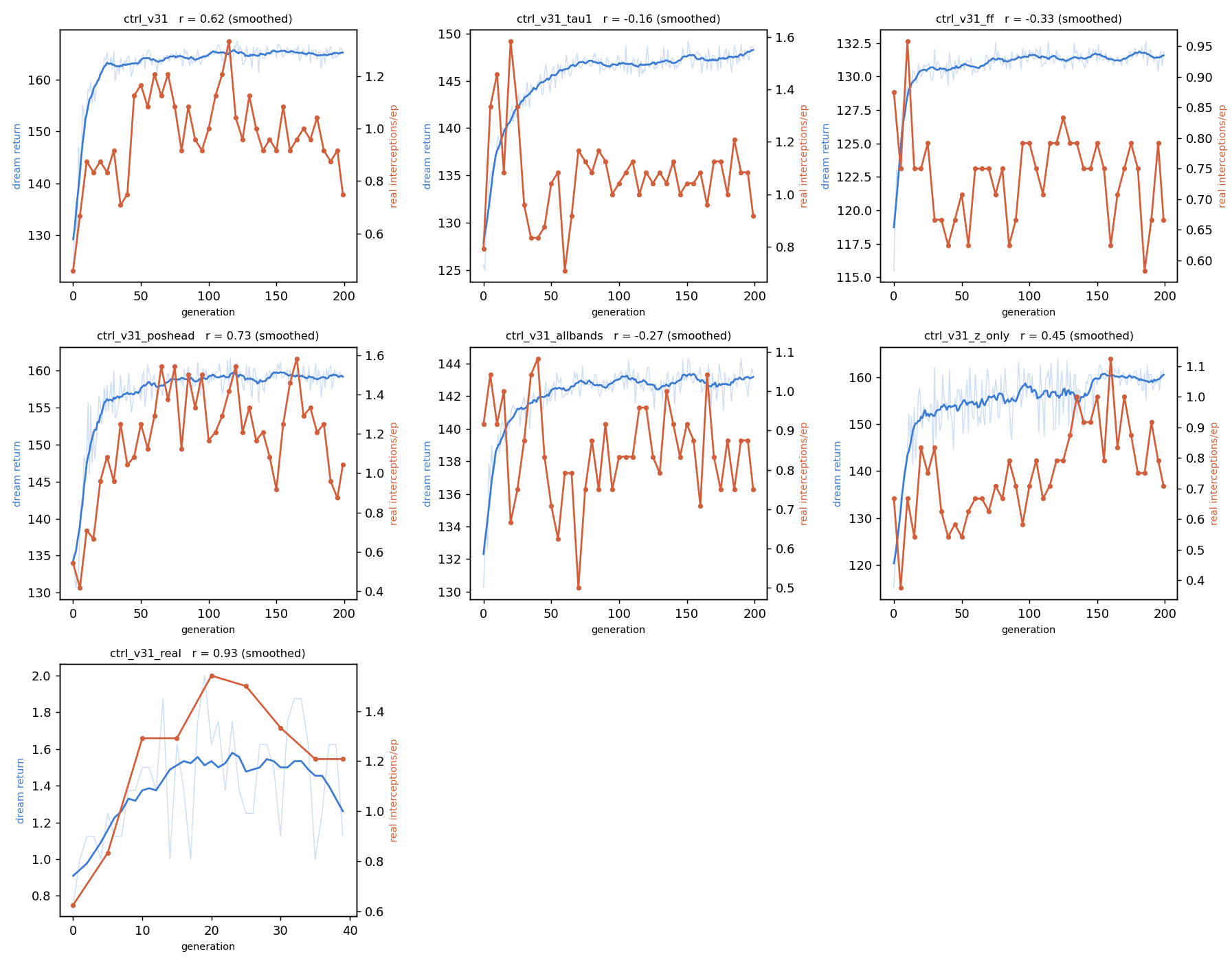
Transfer is much better than v3’s and it does not predict skill. v3’s best
controller had r = −0.01; here three runs are at 0.45–0.73. But the best
controller in the table below, ctrl_v31_tau1, has r = −0.16, and the run
with the best transfer that is not privileged (ctrl_v31, 0.62) is 0.16
interceptions per visit worse. Dream fitness is still a quantity in each M’s
own head and still not comparable across rows; the within-run correlation turns
out not to be worth much either.
ctrl_v31_real’s panel is the one to look at for a different reason: its real
score peaks at generation 20 (2.0 interceptions/ep on 24 episodes) and then
declines for the remaining 20 generations. Optimising interceptions directly
on 8 episodes per candidate overfits the seed block.
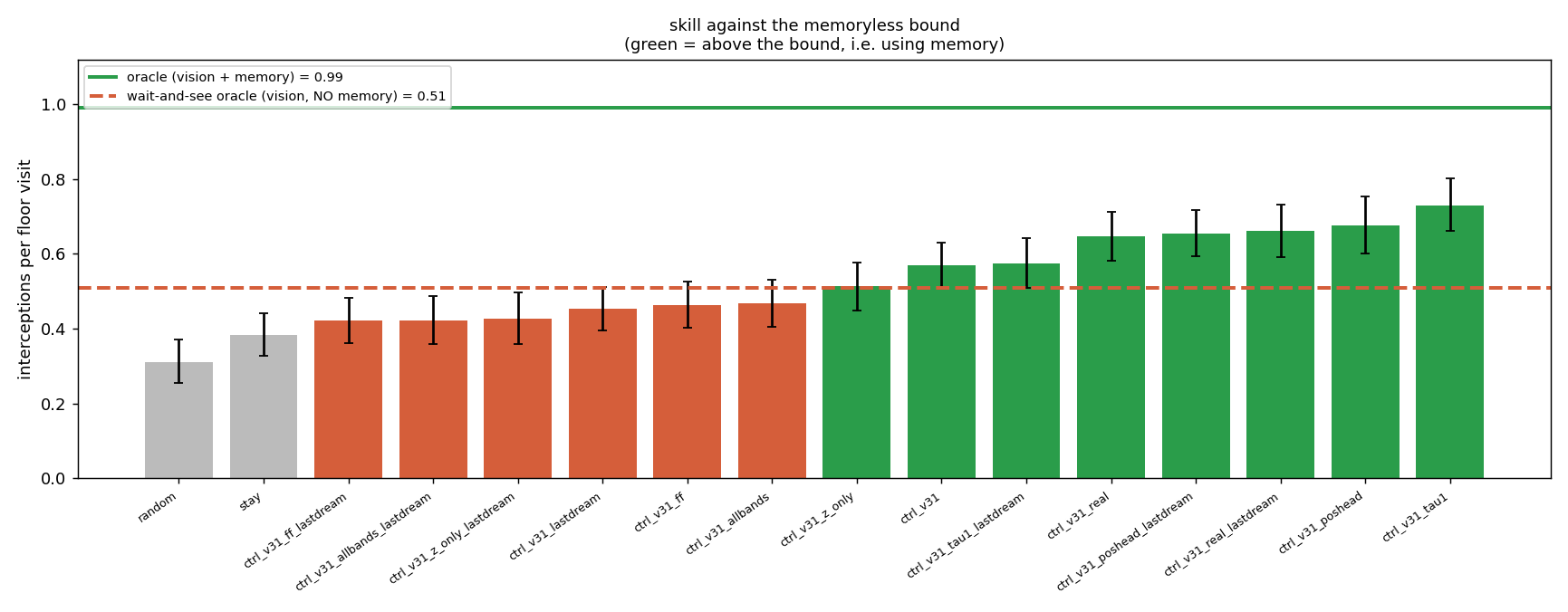
4. The headline: every row against the memoryless bound
150 episodes × 200 steps, seeds 5000–5149, identical starts for every row, band
(0.13, 0.63), paddle 0.16. Full table with CIs in
runs/ctrl_eval_v31/summary.md.
| controller | interceptions/visit | vs the bound |
|---|---|---|
oracle (vision + memory) |
0.99 [0.98, 1.00] | +0.48 |
ctrl_v31_tau1 (fair, τ=1.0) |
0.73 [0.66, 0.80] | +0.22 |
ctrl_v31_poshead (PRIVILEGED) |
0.68 [0.60, 0.75] | +0.17 |
ctrl_v31_real_lastdream (1.07 M real steps) |
0.66 [0.59, 0.73] | +0.15 |
ctrl_v31_real |
0.65 [0.58, 0.71] | +0.14 |
ctrl_v31 (fair, τ=0.0) |
0.57 [0.51, 0.63] | +0.06 |
ctrl_v31_tau1_lastdream |
0.57 [0.51, 0.64] | +0.06 |
ctrl_v31_z_only (negative control) |
0.51 [0.45, 0.58] | +0.00 |
wait_and_see (vision, NO memory) |
0.51 [0.44, 0.58] | — |
ctrl_v31_allbands |
0.47 [0.41, 0.53] | −0.04 |
ctrl_v31_ff (floor) |
0.46 [0.40, 0.53] | −0.05 |
ctrl_v31_lastdream |
0.45 [0.40, 0.51] | −0.06 |
ctrl_v31_z_only_lastdream |
0.43 [0.36, 0.50] | −0.08 |
ctrl_v31_allbands_lastdream |
0.42 [0.36, 0.49] | −0.09 |
ctrl_v31_ff_lastdream |
0.42 [0.36, 0.48] | −0.09 |
stay |
0.38 [0.33, 0.44] | −0.13 |
random |
0.31 [0.25, 0.37] | −0.20 |
Five of the seven trained runs are above the memoryless bound, and the top one is above it by 0.22 with non-overlapping intervals ([0.66, 0.80] against [0.44, 0.58]). This is the result v3 was designed to produce and could not, because on v3’s band there was 0.01 of headroom to produce it in.
The ordering is also, for the first time in this project, the ordering the labels predict: fair (0.73) ≥ privileged (0.68) > z-only negative control (0.51) ≈ the bound > feed-forward floor (0.46).
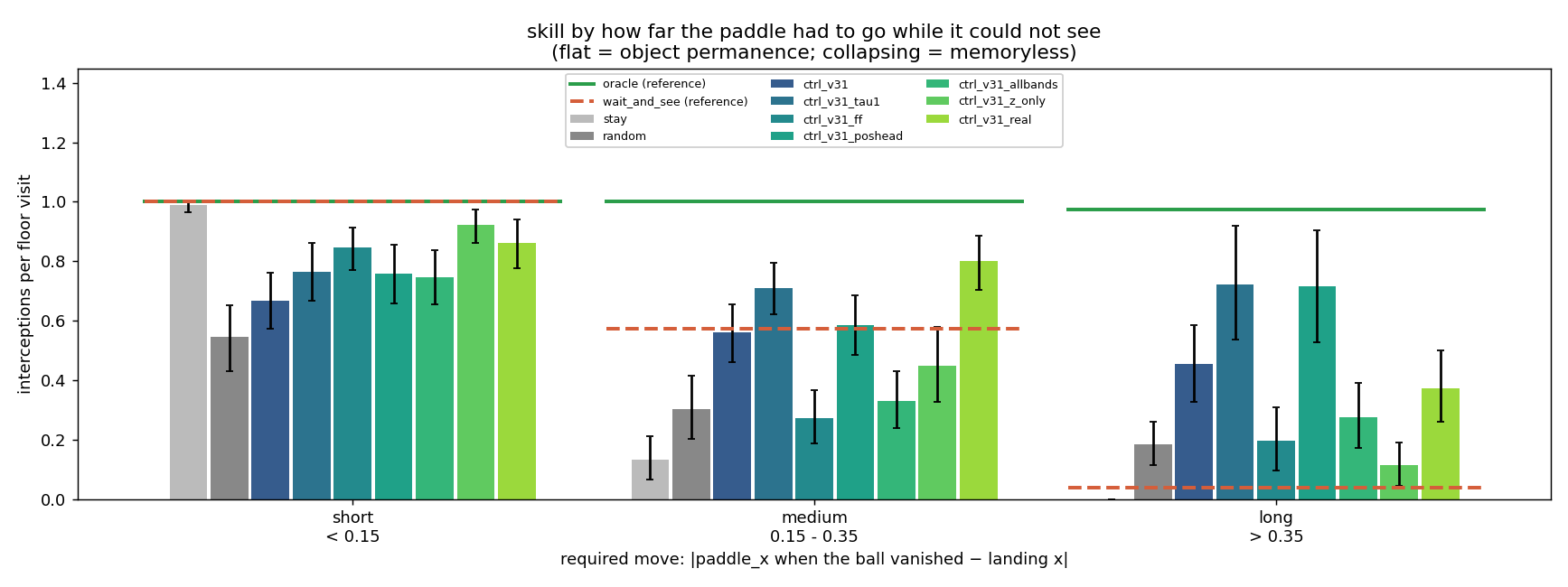
5. By required move — the shape, not the number
The required move is |paddle_x at the frame the ball became fully hidden on its way down − the ball’s landing x|. A policy with object permanence is flat across the bins; a memoryless one collapses on long moves. Counts per cell are in the table below it, and the bins are policy-dependent (§9.4).
| controller | overall | short (<0.15) | medium (0.15–0.35) | long (>0.35) |
|---|---|---|---|---|
stay |
0.38 | 0.99 | 0.13 | 0.00 |
random |
0.31 | 0.54 | 0.30 | 0.18 |
oracle |
0.99 | 1.00 | 1.00 | 0.97 |
wait_and_see (no memory) |
0.51 | 1.00 | 0.57 | 0.04 |
ctrl_v31_tau1 |
0.73 | 0.76 | 0.71 | 0.72 |
ctrl_v31_poshead |
0.68 | 0.76 | 0.59 | 0.71 |
ctrl_v31_poshead_lastdream |
0.65 | 0.69 | 0.66 | 0.61 |
ctrl_v31_real |
0.65 | 0.86 | 0.80 | 0.37 |
ctrl_v31_real_lastdream |
0.66 | 0.96 | 0.76 | 0.36 |
ctrl_v31 |
0.57 | 0.67 | 0.56 | 0.45 |
ctrl_v31_tau1_lastdream |
0.57 | 0.90 | 0.47 | 0.24 |
ctrl_v31_z_only |
0.51 | 0.92 | 0.45 | 0.11 |
ctrl_v31_allbands |
0.47 | 0.75 | 0.33 | 0.28 |
ctrl_v31_ff |
0.46 | 0.85 | 0.27 | 0.20 |
ctrl_v31_lastdream |
0.45 | 0.75 | 0.35 | 0.19 |
Visit counts (short / medium / long): oracle 72/102/76, wait_and_see
63/112/78, ctrl_v31_tau1 89/107/54, ctrl_v31_poshead 83/94/84,
ctrl_v31_real 80/80/102, ctrl_v31 90/107/64, ctrl_v31_ff 97/103/61,
ctrl_v31_z_only 89/105/71. Every cell has 54+ visits, so the long bin is a
real measurement rather than v3’s handful.
The split finally measures what it was designed to measure. wait_and_see
is 1.00 / 0.57 / 0.04: on v3’s band it was 1.00 / 1.00 / 0.97 and the split
said nothing. And ctrl_v31_tau1 is 0.76 / 0.71 / 0.72 — flat, which is the
object-permanence signature, in a bin where a policy with perfect vision and no
memory scores 0.04.
The z-only negative control fired the right way this time. In v3 it won
the long bin (0.91) and destroyed the interpretation. Here a policy that
provably cannot know anything about a hidden ball scores 0.11 on long moves,
exactly on wait_and_see’s 0.04–0.11 — and 0.92 on short ones. The difference
between it and ctrl_v31_tau1 (0.72 long) is memory and nothing else, since
they share V, M and the optimiser and differ only in whether h is an input.
The real-trained controller is the shape of a reaction policy. 0.86 / 0.80 / 0.37: the best medium-bin score of any row, and a collapse on long moves. With 5.4× the real experience, optimising interceptions directly, it learned to react better than anything else and did not learn to commit.
6. The reach curve
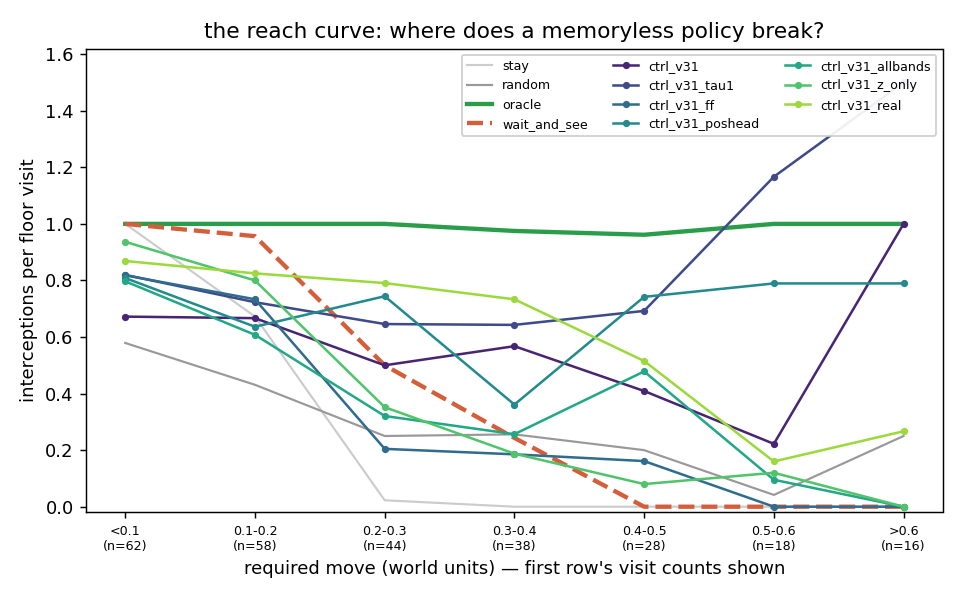
| controller | <0.1 | 0.1–0.2 | 0.2–0.3 | 0.3–0.4 | 0.4–0.5 | 0.5–0.6 | >0.6 |
|---|---|---|---|---|---|---|---|
oracle |
1.00 | 1.00 | 1.00 | 0.97 | 0.96 | 1.00 | 1.00 |
wait_and_see |
1.00 | 0.96 | 0.50 | 0.24 | 0.00 | 0.00 | 0.00 |
ctrl_v31_tau1 |
0.82 | 0.72 | 0.65 | 0.64 | 0.69 | 1.17† | 1.50† |
ctrl_v31_poshead |
0.81 | 0.64 | 0.74 | 0.36 | 0.74 | 0.79 | 0.79 |
ctrl_v31_real |
0.87 | 0.82 | 0.79 | 0.73 | 0.52 | 0.16 | 0.27 |
ctrl_v31 |
0.67 | 0.67 | 0.50 | 0.57 | 0.41 | 0.22 | 1.00† |
ctrl_v31_ff |
0.82 | 0.73 | 0.20 | 0.19 | 0.16 | 0.00 | 0.00 |
ctrl_v31_z_only |
0.94 | 0.80 | 0.35 | 0.19 | 0.08 | 0.12 | 0.00 |
† 2–6 visits. Above 1.0 is possible — a floor visit can contain two separate
contact runs — and in these slices it is noise; the counts are in summary.md.
The memoryless bound breaks at 0.2 and is at zero by 0.4. v3’s stayed at the ceiling out to 0.6, which is why v3’s whole table was uninformative. Here every slice from 0.2 outward carries information, and the two rows that stay up across it are the τ=1 fair controller and the privileged one.
7. Paddle motion during occlusion
Descending hidden runs (mean 21.7 frames, against v3’s 9.6), restricted to visits whose required move exceeds 0.15.
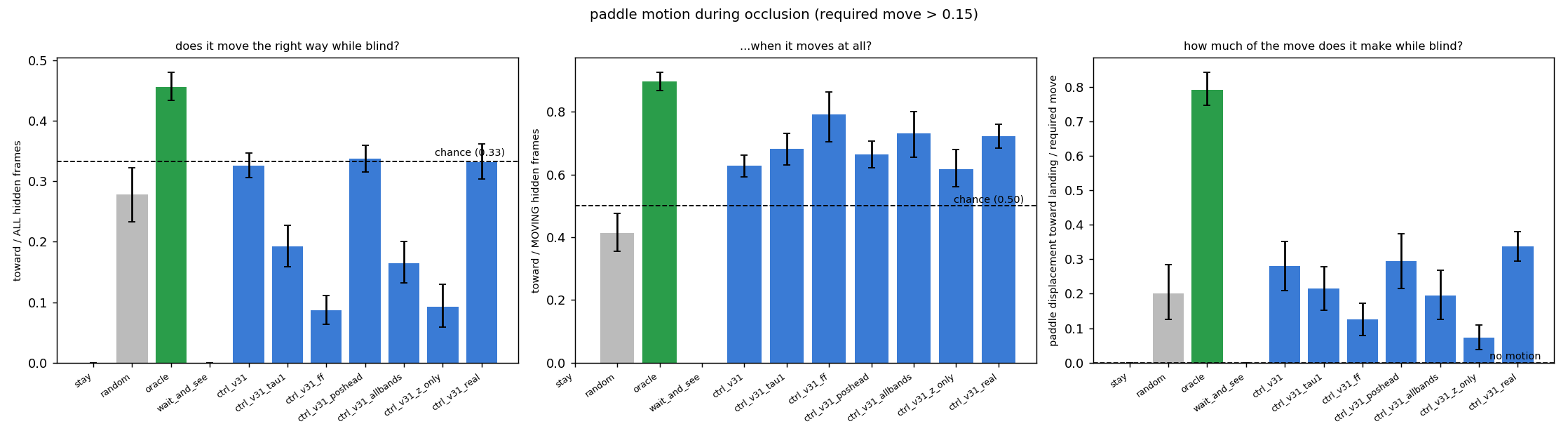
| controller | moved on (frac. of hidden frames) | toward / ALL hidden (chance 1/3) | toward / MOVING (chance 1/2) | displacement / required move |
|---|---|---|---|---|
stay, wait_and_see |
0.000 | 0.000 | — | 0.000 |
random |
0.671 | 0.278 | 0.414 [0.36, 0.48] | 0.202 [0.13, 0.28] |
oracle |
0.509 | 0.456 | 0.897 [0.87, 0.93] | 0.793 [0.75, 0.84] |
ctrl_v31 |
0.519 | 0.326 | 0.628 [0.59, 0.66] | 0.280 [0.21, 0.35] |
ctrl_v31_tau1 |
0.283 | 0.193 | 0.682 [0.63, 0.73] | 0.215 [0.15, 0.28] |
ctrl_v31_ff (floor) |
0.109 | 0.086 | 0.791 [0.70, 0.86] | 0.125 [0.08, 0.17] |
ctrl_v31_poshead |
0.508 | 0.338 | 0.665 [0.62, 0.71] | 0.296 [0.22, 0.38] |
ctrl_v31_poshead_lastdream |
0.511 | 0.369 | 0.723 [0.68, 0.76] | 0.420 [0.35, 0.50] |
ctrl_v31_allbands |
0.225 | 0.165 | 0.730 [0.66, 0.80] | 0.195 [0.13, 0.27] |
ctrl_v31_z_only (no memory) |
0.149 | 0.092 | 0.617 [0.56, 0.68] | 0.072 [0.04, 0.11] |
ctrl_v31_real |
0.460 | 0.332 | 0.722 [0.68, 0.76] | 0.337 [0.29, 0.38] |
ctrl_v31_real_lastdream |
0.750 | 0.486 | 0.648 [0.63, 0.67] | 0.367 [0.32, 0.42] |
This is the number that changed most from v3, and it is a change in kind.
v3’s best controller moved on 13 % of hidden frames and covered 3 % of the
required move. v3.1’s fair controller moves on 52 % and covers 28 %;
ctrl_v31_real covers 34 %, and the privileged poshead_lastdream 42 %,
against the oracle’s 79 %. In v3 “no trained controller commits during the
occlusion in any quantity that affects an outcome” was the finding; here they
commit, and the commitment is a third to a half of the oracle’s.
The ff floor’s high toward-when-moving is the trap the v3 log flagged, seen
from the other side. It scores 0.791 — higher than the fair controller — on
10.9 % of frames, i.e. it almost never moves and when it does it is usually
after the ball has re-emerged. z_only is the clean control: 0.617
toward-when-moving but 0.072 of the distance, because it has nothing to aim
at until the ball comes out.
8. The other two bands — with the encoder confound removed
60 episodes each, seeds 6000+/6100+. In v3 these bands cost the encoder 133–262× reconstruction error and no split of the result could separate “longer occlusion” from “broken encoder”. The v3.1 VAE was trained on all three:
| dataset | band | recon MSE | mean hidden run |
|---|---|---|---|
data/v31/val |
(0.13, 0.63) | 0.00006 | 24.6 |
data/v31/short |
(0.13, 0.45) | 0.00010 | 12.2 |
data/v31/long |
(0.13, 0.78) | 0.00006 | 30.9 |
A 1.7× spread, against v3’s 262×. The rows below are about the controller.
| controller | (0.13, 0.45) — 10 hidden frames | (0.13, 0.63) — 22 | (0.13, 0.78) — 32 |
|---|---|---|---|
oracle |
0.99 | 0.99 | 0.97 |
wait_and_see |
0.54 | 0.51 | 0.50 |
ctrl_v31 |
0.55 [0.45, 0.65] | 0.57 [0.51, 0.63] | 0.56 [0.46, 0.65] |
ctrl_v31_ff (floor) |
0.43 | 0.46 | 0.47 |
ctrl_v31_poshead (privileged) |
0.30 [0.23, 0.38] | 0.68 [0.60, 0.75] | 0.16 [0.10, 0.22] |
And ctrl_v31’s displacement fraction during occlusion goes 0.099 → 0.280 →
0.491 as the occlusion lengthens: the longer it is blind, the more of the move
it makes while blind, which is what a policy acting on a remembered position
should do.
Two surprises here. First, the memoryless bound barely moves across the
three bands (0.54 / 0.51 / 0.50) — unlike v3, where it fell 0.99 → 0.86 → 0.65.
The reason is that v3.1’s band bottom is already at contact height on all three,
so the bound is pinned near the stand-still floor and only the top edge moves;
lengthening the occlusion cannot hurt a policy that had already given up.
Second, the privileged controller collapses off its training band — 0.30 and
0.16, far below the feed-forward floor — while the fair one is flat. Whatever
poshead’s h gives its controller is tied to the band geometry it was trained
on in a way the fair model’s is not. On 60 episodes that is a strong effect
(CIs nowhere near 0.5) but one band-pair, and it should be replicated before it
is believed.
9. Surprises and honest failures
9.1 The best controller was trained in the dream the selection rule rejected.
ctrl_v31_tau1 (τ = 1.0) scores 0.73; ctrl_v31 at the chosen τ = 0 scores
0.57. The rule picked τ = 0 for the baseline because its τ ≥ 0.5 dream arrives
below the band 4–6× too often — and that over-arriving, physically wrong dream
produced the better policy by 0.16 interceptions per visit. The rule was applied
honestly and in advance, and it was wrong. A defensible post-hoc reading is that
sampling noise acts as exploration pressure on a dream with no real trajectories
in it; I did not test that.
9.2 The dream is dead and the controllers work anyway. These two facts sit
together and §0.3 is the only bridge I have: the reward head is a faithful
tracking signal on the latents the dream visits (r = 0.92–0.98 with the decoded
gap), and h carries the hidden ball’s x at R² 0.52 (README_V31 §4.3). So
CMA-ES can find “move toward where h says the ball is” without ever seeing a
dreamed ball arrive. The dream is working as a feature-conditioned reward
model, not as a simulator, and calling this “training in a world model” would
overclaim by a lot.
9.3 params_last_dream is much worse than params_best_real on every
zh dream row — 0.73 → 0.57 on tau1, 0.57 → 0.45 on ctrl_v31 — and
better on ctrl_v31_real (0.65 → 0.66). Selecting on 24 real episodes every
5 generations is buying 0.05–0.16 interceptions per visit, which is the price of
the dream being exploitable. The gap is largest in the long bin (0.72 → 0.24).
9.4 The required-move bins are policy-dependent, as in v3: the move is
measured from this policy’s own paddle, so the bins hold different visits for
different rows (ctrl_v31_tau1 generates 54 long visits, ctrl_v31_real 102).
This conditions on a post-treatment variable. Counts are reported per row and
the episodes and seeds are identical throughout.
9.5 The measured bound is 0.51, not the design sweep’s 0.48. Same policy, same world, 150 episodes against the sweep’s 60. Every “above the bound” claim here uses the 0.51 measured on the same episodes as the rows it is compared to.
9.6 allbands is a worse controller as well as a worse dynamics model.
0.47, below the bound and barely above the ff floor, consistent with README_V31
§4.10’s finding that band diversity helps the encoder and not the dynamics.
9.7 Transfer correlation is not a model-selection signal. §3: the two best transfers (0.73 privileged, 0.62 fair-τ0) belong to the second- and fifth-ranked controllers, and the best controller has r = −0.16.
9.8 What is not shown. No causal test that the controllers use h’s
hidden-x specifically (v2’s eval_ctrl_intervention was not re-run on v3.1);
no seed replication — every row is one CMA-ES seed, and the 0.73-vs-0.68
fair-vs-privileged ordering is well within what a second seed could move.
10. The GIFs
runs/ctrl_eval_v31/real_play_ctrl_v31.gif— seed 5036,ctrl_v31(τ = 0, the fair model). Required move 0.63, 26 hidden frames, 13 of them moving toward the landing x, 3 interceptions in the episode. CHERRY-PICKED out of the 150 evaluation episodes as the longest required move the policy moved through, so it is a demo that the behaviour exists, not a sample of the average episode — §7 is the average, and the average is 52 % of hidden frames moved and 28 % of the distance covered.runs/ctrl_eval_v31/dream_play_ctrl_v31.gif— the same controller inside its own dream at τ = 0, decoded by V, best of 16 by predicted contact. The ball is visible for about two frames and then never again; the rest is a correctly rendered band and a paddle sliding around under it. This is §0’s verdict as a picture, and it is the single most important thing to look at before believing any sentence in this document that contains the word “dream”.
11. Two extra runs, and the matched negative control they supply
Provenance, because it matters for how much weight these carry.
runs/ctrl_v31_tau0.5/ and runs/ctrl_v31_z_only_tau1/ were not launched by
runs/_train_ctrl_v31.sh; they appeared on disk during this stage, trained by
someone else, and were found afterwards. Their recorded args are byte-for-byte
this stage’s protocol apart from the two fields their names give (τ = 0.5 with
zh; τ = 1.0 with z only), so they are directly comparable — but they are
not this stage’s experiment and they were not pre-registered by it. They were
scored on the identical 150 episodes (seeds 5000–5149) into
runs/ctrl_eval_v31_extra/; the four
reference rows come out identical to §4, which is the check that the two
evaluations are the same evaluation.
| controller | overall | short | medium | long | displacement while blind |
|---|---|---|---|---|---|
ctrl_v31_tau0.5 (fair, τ=0.5) |
0.61 [0.55, 0.68] | 0.91 | 0.50 | 0.37 | 0.074 |
ctrl_v31_tau0.5_lastdream |
0.43 [0.37, 0.50] | 0.80 | 0.39 | 0.07 | −0.019 |
ctrl_v31_z_only_tau1 (matched control) |
0.51 [0.44, 0.57] | 0.93 | 0.41 | 0.06 | 0.018 |
ctrl_v31_z_only_tau1_lastdream |
0.62 [0.55, 0.70] | 0.89 | 0.54 | 0.43 | 0.022 |
The matched control is the strongest single piece of evidence in this
document. §4’s z_only was trained at τ = 0 while the best controller was
trained at τ = 1, so the control was not matched. This one is: same V, same M,
same τ = 1.0, same optimiser, same 200 generations — the only difference is
that h is removed from the policy’s inputs, which makes knowing anything about
a hidden ball impossible by construction. It scores 0.51 against
ctrl_v31_tau1’s 0.73, and 0.06 against 0.72 on long moves, sitting
exactly on the memoryless bound. The 0.22 is h.
τ = 0.5 also fills in the temperature curve: 0.57 (τ=0) → 0.61 (τ=0.5) → 0.73 (τ=1.0), monotone in the temperature, and monotone in the opposite direction to what the §0 selection rule ranked.
11.1 The caveat this control also exposed
ctrl_v31_z_only_tau1_lastdream scores 0.43 on long moves — above the
memoryless bound’s 0.04, on 69 visits, from a policy that provably cannot know
where a hidden ball is. Its occlusion behaviour says how: it moves on 37 % of
hidden frames, toward the landing point on 47.5 % of those (chance), and
covers 2 % of the required move. It is wandering, not committing.
The mechanism is a property of the metric that no row in §5 made visible. A
floor visit is the whole stretch the ball spends below paddle_top + r, which
at |vy| ≈ 0.02 is about six frames — during which the paddle can travel 0.18,
more than its own width. So “interceptions per floor visit” credits a late
arrival during the visit, not only a paddle that was already there, and a
policy that happens to be moving the right way when the ball re-emerges can win
long-bin visits without ever having committed. wait_and_see cannot exploit
this because it is frozen, which is exactly why it scores 0.04.
This does not overturn §4–§7 — the displacement-during-occlusion column is
immune to it (every z-only parameter set is at 0.018–0.072 against the fair
controllers’ 0.215–0.280), and the matched control’s params_best_real row is
at 0.06 — but it means the long bin is “reached the landing point in time”,
not “committed early”, and only the paddle-motion table separates those two.
Reported here rather than fixed: changing the visit definition now would make
every number in this document incomparable with v3’s.
The four questions the brief asked, answered plainly
(i) Does any dream-trained controller beat the memoryless bound, and by how much?
Yes — five of seven, and the best by +0.22. ctrl_v31_tau1 scores 0.73
[0.66, 0.80] interceptions per floor visit against the memoryless bound’s
0.51 [0.44, 0.58] and the full oracle’s 0.99, with non-overlapping intervals
on 150 episodes. It is flat across the required-move split (0.76 / 0.71 /
0.72) where the memoryless bound collapses to 0.04, which is the shape the
design predicted for a policy with object permanence and the shape v3 could not
test for. It closes 46 % of the bound-to-oracle gap.
The matched negative control (§11) is what turns that from a correlation
into an attribution: the same V, the same M, the same τ = 1.0 and the same
optimiser, with h removed from the policy’s inputs so that knowing anything
about a hidden ball is impossible by construction, scores 0.51 — exactly the
bound — and 0.06 on long moves. The 0.22 is h.
Two honest qualifications. Skill is monotone in the training temperature (0.57 / 0.61 / 0.73 for τ = 0 / 0.5 / 1.0), which the §0 selection rule ranked the other way round; and the long bin credits a late arrival during a six-frame floor visit as well as an early commitment (§11.1), so the behavioural claim rests on the displacement column of §7, not on the long bin alone.
(ii) Does the privileged-ceiling controller beat the fair one — is horizontal permanence worth something for play when the task demands it?
No, and this is the third version of this project in which it does not.
ctrl_v31_poshead scores 0.68 against the fair ctrl_v31_tau1’s 0.73 (CIs
overlap heavily) and collapses off its training band (0.30 and 0.16, below the
feed-forward floor, against the fair controller’s flat 0.55 / 0.57 / 0.56). The
honest reading is the one README_V31 §4.3 set up: on v3.1 the fair model’s
hidden-x memory already equals the privileged model’s (R² 0.52 vs 0.48), so
there was nothing left for the position head to add, and what it did add did not
generalise. Horizontal permanence is worth something for play here — that is
answer (i), and the z-only control at 0.11 on long moves is the proof — but
supervising it explicitly buys nothing over letting the likelihood find it.
(iii) Does the real-trained controller beat them — is the dream or the policy class the limit?
No, and it is neither: it is the objective. ctrl_v31_real — the same
819-parameter linear policy, the same inputs including h, 1.07 M real steps
(5.4× the dream runs’ total real budget), fitness measured as real interceptions
— scores 0.65, below ctrl_v31_tau1’s 0.73. Its shape is the giveaway:
0.86 / 0.80 / 0.37 across short / medium / long, the best medium-bin score
in the table and a collapse on exactly the visits that require committing
early. Direct optimisation of interceptions on 8 episodes per candidate finds
the best reaction policy and overfits its seed block (its real score peaks at
generation 20 of 40 and then declines). So the policy class is not the limit —
819 parameters clearly suffice for 0.73 — and the dream is not a handicap
either. What the dream supplies that real rollouts do not is a dense reward
at every step, which is the signal that pays for moving in the dark.
(iv) Does the fair controller move the paddle toward the landing point while the ball is hidden?
Yes, and this is the v3 result reversed. ctrl_v31 moves on 52 % of
hidden frames (v3: 13 %), moves toward the landing point on 63 % of the
frames it moves (chance 50 %, CI [0.59, 0.66]), and covers 28 % of the
required move while blind (v3: 3 %) against the oracle’s 79 % and the
memoryless bound’s structural 0.000. The z-only control, which cannot know
anything about a hidden ball, covers 7 %. And the behaviour scales with the
task: on the short band ctrl_v31 covers 10 % of the move while blind, on the
default 28 %, on the long band 49 % — the longer it cannot see, the more of
the journey it makes anyway.