v3.1 stages one and two — the same questions, in a world that needs the answer
Technical log for v3.1: the re-geometried occlusion environment, its VAE, and
its dynamics models. The design and the oracle sweep that motivated it are in
docs/v3/06_v31_design.md and
runs/v31_design/sweep.md; read those first.
v3’s answers to the same questions — which this document re-asks on the new
geometry — are in README_V3.md, README_M3.md
and README_FIX3.md. Hardware: Apple M1, 8 GB;
python; every command from the repo root. No
existing dataset or checkpoint was modified.
Why v3.1 exists, in one sentence. v3’s band was placed by an argument about frames that ignored the paddle’s width, and a two-line memoryless oracle then caught 99% of balls — so v3 measured object permanence but never tested whether anything needed it. v3.1 drops the band’s bottom edge to contact height (0.13) and narrows the paddle to 0.16, which takes the memoryless oracle from 1.00 to 0.48 against a full oracle’s 0.99.
Stage one, up front. The re-geometried world hides the ball on 42.5% of
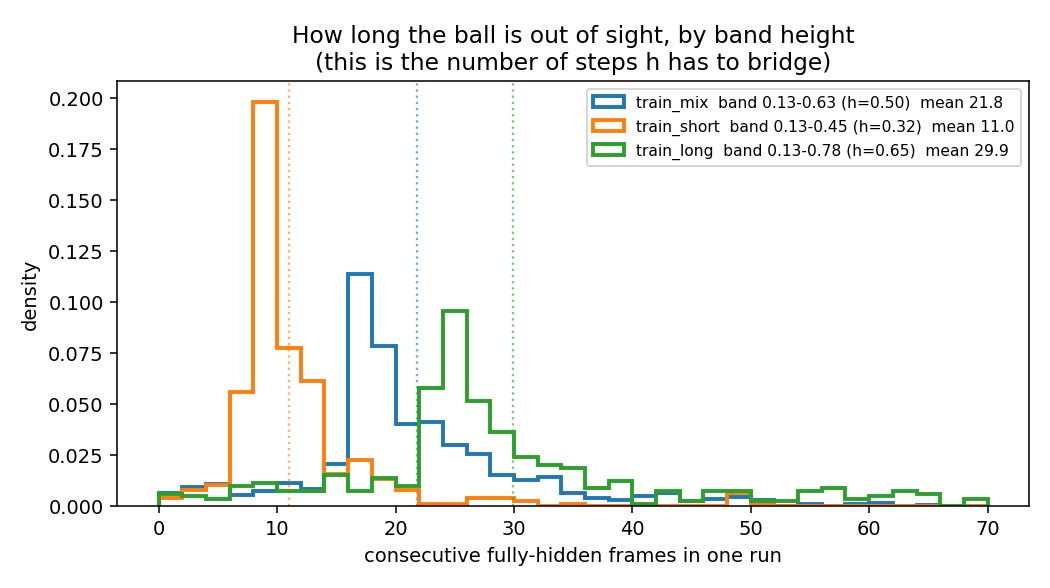
frames (v3: 17.6%) for a mean of 21 frames per crossing (v3: 9.4), and
36% of hidden runs now contain a side-wall bounce that happens out of sight
(v3: ~12 runs in the whole default-band val set). The encoder was trained on
all three band heights at once, and that removed v3’s worst confound outright:
reconstruction MSE is 0.00006 / 0.00010 / 0.00006 across the three bands,
a 1.7× spread where v3’s single-band encoder had 133–262×. Ball position is
recoverable from one frame’s mu at R² 0.989 (x, poly-2) / 0.937 (y, linear)
when visible,
0.723 / 0.852 when partial, and ≤ 0 when hidden — still the correct
answer. The band’s own height, now a three-valued nuisance factor, is carried
perfectly (R² 0.997, 100.0% nearest-of-three) and costs nothing:
total KL fell from 11.87 to 11.32.
1. Commands, in order, with wall clock
# ---- data: 9 splits, 865 episodes, 173k frames -- 75 s, 1.9 GB
bash runs/v31_env/collect_v31.sh          # the nine `worldsim.collect` calls
python -m worldsim.v3_figures \
    --data data/v31/train data/v31/train_short data/v31/train_long \
    --gif-data data/v31/val_mix --gif-max-len 26 --gif-pad 10 \
    --hist-data data/v31/train_mix data/v31/train_short data/v31/train_long \
    --out runs/v31_env                                              # 9 s

# ---- the VAE, on ALL THREE bands -- 6579 s (110 min), 110 s/epoch on mps
python -m wm.train_vae \
    --data data/v31/train data/v31/train_mix data/v31/train_short data/v31/train_long \
    --val data/v31/val --out runs/vae_v31 \
    --epochs 60 --z-dim 16 --free-bits 0.5 --warmup-epochs 5 \
    --device mps --eval-every 10

# ---- stage-one analysis + latents for all nine splits -- 88 s total
bash runs/_stage1_v31.sh
#   wm.analyze                      on data/v31/probe
#   wm.analyze_v3                   on probe / short / long  (once per band)
#     ... with --band-roots data/v31/probe data/v31/short data/v31/long
#   wm.cache_latents                on all nine splits

# ---- the four dynamics models, concurrently, OMP_NUM_THREADS=2
bash runs/_train_rnn_v31.sh
#   rnn_v31          baseline (the fair model)                   1237 s
#   rnn_v31_ff       --feedforward (the floor)                    504 s
#   rnn_v31_poshead  --pos-head --w-pos 1.0 (PRIVILEGED ceiling)  1274 s
#   rnn_v31_emerge   --rollout-loss-steps 24 --rollout-loss-weight 1.0
#                    --emerge-weight 5 (the best fair fix from v3) 1861 s
# All four at once with OMP_NUM_THREADS=2 on 8 cores, so these are 2-3x the
# solo per-epoch cost. COMMON = --data data/v31/train data/v31/train_mix
#   --val data/v31/val data/v31/val_mix --epochs 35 --eval-every 2

# ---- the optional fifth: the same fair model on all four training roots  624 s
python -m wm.train_rnn --out runs/rnn_v31_allbands --epochs 35 --eval-every 2 \
    --data data/v31/train data/v31/train_mix data/v31/train_short data/v31/train_long \
    --val data/v31/val data/v31/val_mix

# ---- evaluation -- 22 min for everything
bash runs/_eval_rnn_v31.sh
#   wm.eval_rnn + wm.eval_conservation, once per model
#   wm.eval_permanence_v3, ALL FOUR MODELS IN ONE PASS, so that every model is
#     scored against the same frozen probe, split and baselines:
#       --bands short=data/v31/short long=data/v31/long
#       --extra 16 --max-age 40
#   wm.compare_fix_v3 -> runs/rnn_v31_permanence_comparison.png (+ .md, .json)

# the allbands row, scored the same way (baseline and ff rows come out
# byte-identical, which is the determinism check)
python -m wm.eval_permanence_v3 --out runs/rnn_v31_permanence_allbands \
    --vae runs/vae_v31/vae.pt --val data/v31/val data/v31/val_mix \
    --bands short=data/v31/short long=data/v31/long \
    --probe-data data/v31/probe data/v31/val_mix --extra 16 --max-age 40 \
    --models baseline=runs/rnn_v31/rnn.pt ff=runs/rnn_v31_ff/rnn.pt \
             allbands=runs/rnn_v31_allbands/rnn.pt --skip b e

python -m pytest tests/ -q        # 130 passed (14 of them the new test_v31)
What changed in the code
Everything reused; nothing duplicated. Eight files gained a flag or a generalisation, each with the old behaviour as the default:
| file | change |
|---|---|
worldsim/collect.py |
--paddle-w (default 0.26, the v1–v3 paddle), passed to BoxConfig and recorded in meta["paddle_w"] as well as meta["config"] |
wm/data.py |
FrameDataset / make_loader accept one root or several and concatenate them. Index i inside the first root’s range still addresses that root’s item i, so a single-root run is the multi-root path with one root rather than a separate code path. Roots must agree on resolution and state_names; they are free to differ in band geometry, episode count and episode length |
wm/train_vae.py |
--data / --val are nargs="+" |
wm/analyze_v3.py |
--band-roots: probes mu for the band’s top edge across roots with different band heights — the nuisance factor v3.1 introduced |
wm/eval_permanence_v3.py |
the extra bands are named on the CLI (--bands short=… long=…) instead of being hard-coded as tall/taller; --extra (dream frames past the true exit) and --max-age (last k on the decay curve) are flags. v3’s invocation with no new flags reproduces v3’s published numbers exactly — checked |
wm/eval_controller.py |
make_box_cfg / add_env_args / env_kwargs gained paddle_w (None → BoxConfig’s 0.26), threaded through all three rollout entry points; build_baselines(paddle_w) so the oracle’s dead zone matches the world it is scored in. Stage three needs this |
wm/compare_fix_v3.py |
the pooled band names in the figure come out of the report instead of being spelled “default / tall / taller”; --title |
worldsim/v3_figures.py |
the sample grid takes several roots (one stacked panel per band) and --gif-max-len caps the hidden run the GIF picks |
2. Data
runs/v31_env/collect.log has the full output; every number below also lives in
each split’s meta["occlusion"].
| split | episodes | seed | policy | band | hidden | partial | visible | hidden run mean / median / max | runs with a hidden wall-x bounce |
|---|---|---|---|---|---|---|---|---|---|
train |
150 | 0 | sticky | 0.13–0.63 | 42.5% | 33.3% | 24.2% | 21.0 / 19 / 104 | 36.0% |
train_mix |
300 | 10 | mix 0.5 | 0.13–0.63 | 42.6% | 32.5% | 24.9% | 21.8 / 19 / 104 | 36.2% |
train_short |
100 | 40 | mix | 0.13–0.45 | 20.5% | 33.4% | 46.1% | 11.0 / 9 / 50 | 19.0% |
train_long |
100 | 41 | mix | 0.13–0.78 | 61.0% | 31.8% | 7.2% | 29.9 / 26 / 143 | 47.1% |
val |
15 | 1 | sticky | 0.13–0.63 | 45.1% | 32.7% | 22.2% | 24.6 / 17 / 104 | 32.7% |
val_mix |
20 | 11 | mix | 0.13–0.63 | 42.9% | 32.0% | 25.1% | 23.5 / 20 / 99 | 37.0% |
probe |
120 × 24 | 777 | sticky | 0.13–0.63 | 41.3% | 35.2% | 23.5% | 11.6 / 12 / 24 | 21.6% |
short |
30 | 42 | mix | 0.13–0.45 | 21.1% | 33.7% | 45.2% | 12.2 / 10 / 49 | 26.0% |
long |
30 | 43 | mix | 0.13–0.78 | 62.8% | 31.5% | 5.7% | 30.9 / 25 / 141 | 46.7% |
Three things to read off it.
The default band is now the interesting one. v3’s default hid the ball 17.6%
of the time for 9.4 frames and its taller band (0.16–0.70) managed 46.6% and
23.5. v3.1’s default is at 42.5% and 21.0 — i.e. the v3.1 baseline model is
being asked the question v3 could only ask on an out-of-distribution band.
Hidden wall bounces went from anecdote to sample. 36% of hidden runs contain a side-wall bounce the camera never saw, against 12 scored runs in all of v3’s default-band val set. Experiment (c) — “is the model a simulator or an extrapolator” — finally has power on the default band alone.
The probe split’s runs are shorter (11.6) than the training splits’ (21.0)
even though the band is identical. That is an artefact of its 24-step
episodes, not of the geometry: a run that is still going when the episode ends
is truncated. It matters only for stage one (the probe split is used to fit
position probes, never to measure memory horizon).
Paddle contact. The narrower paddle costs less contact than one might fear, because the tracking policy uses the new width too and the band’s low bottom edge means the ball re-emerges right at contact height:
| policy | v3 (paddle 0.26) | v3.1 (paddle 0.16) | change |
|---|---|---|---|
sticky (train) |
0.540% of steps | 0.457% | −15% |
mix (train_mix) |
0.868% | 0.805% | −7% |
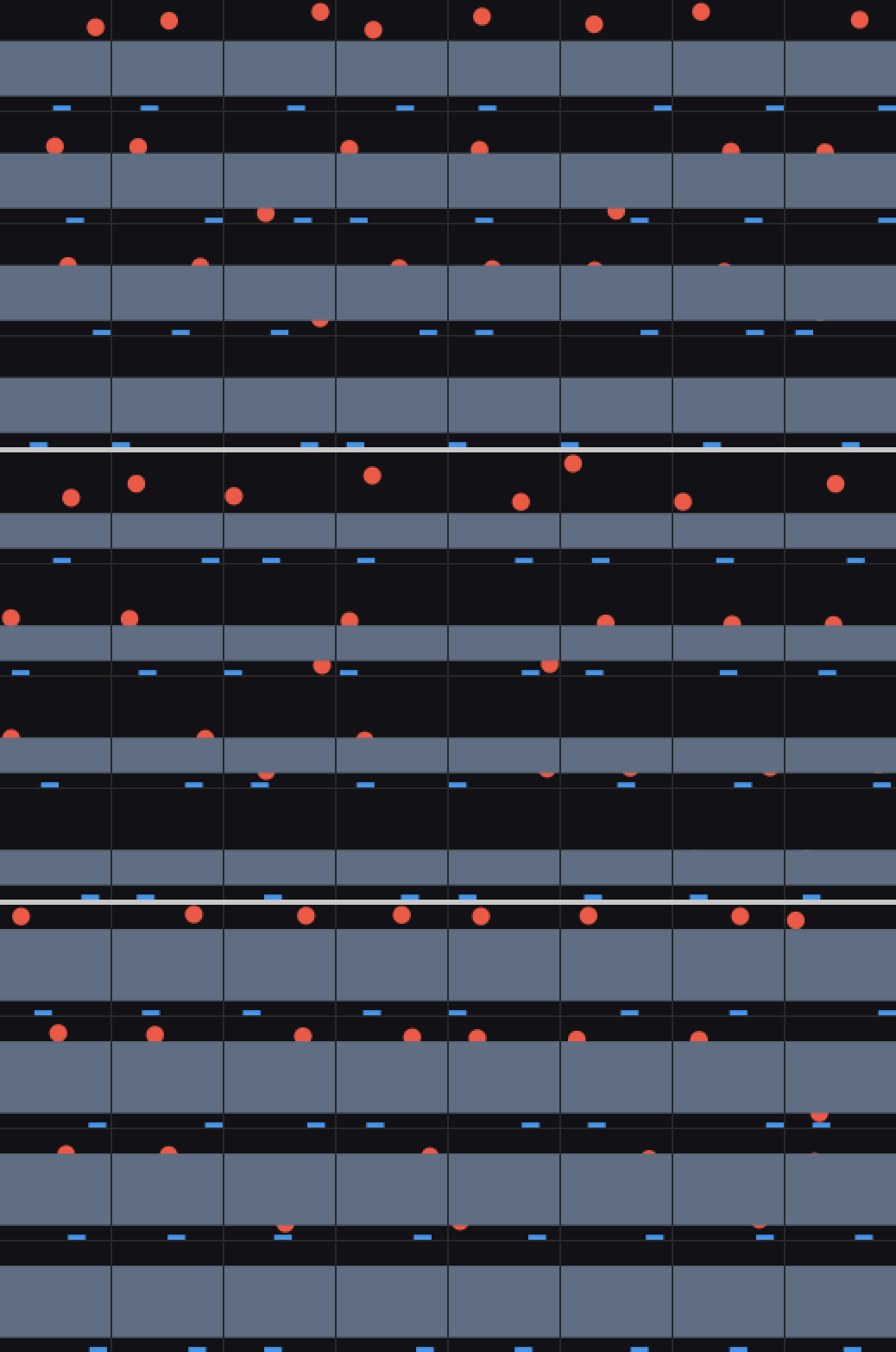
Three stacked panels, one per band (default / short / long), each 32 frames
stratified on ball_visible and ordered visible → hidden. The world is
identical apart from where the slab sits, which is the point: the encoder below
is trained on all three.
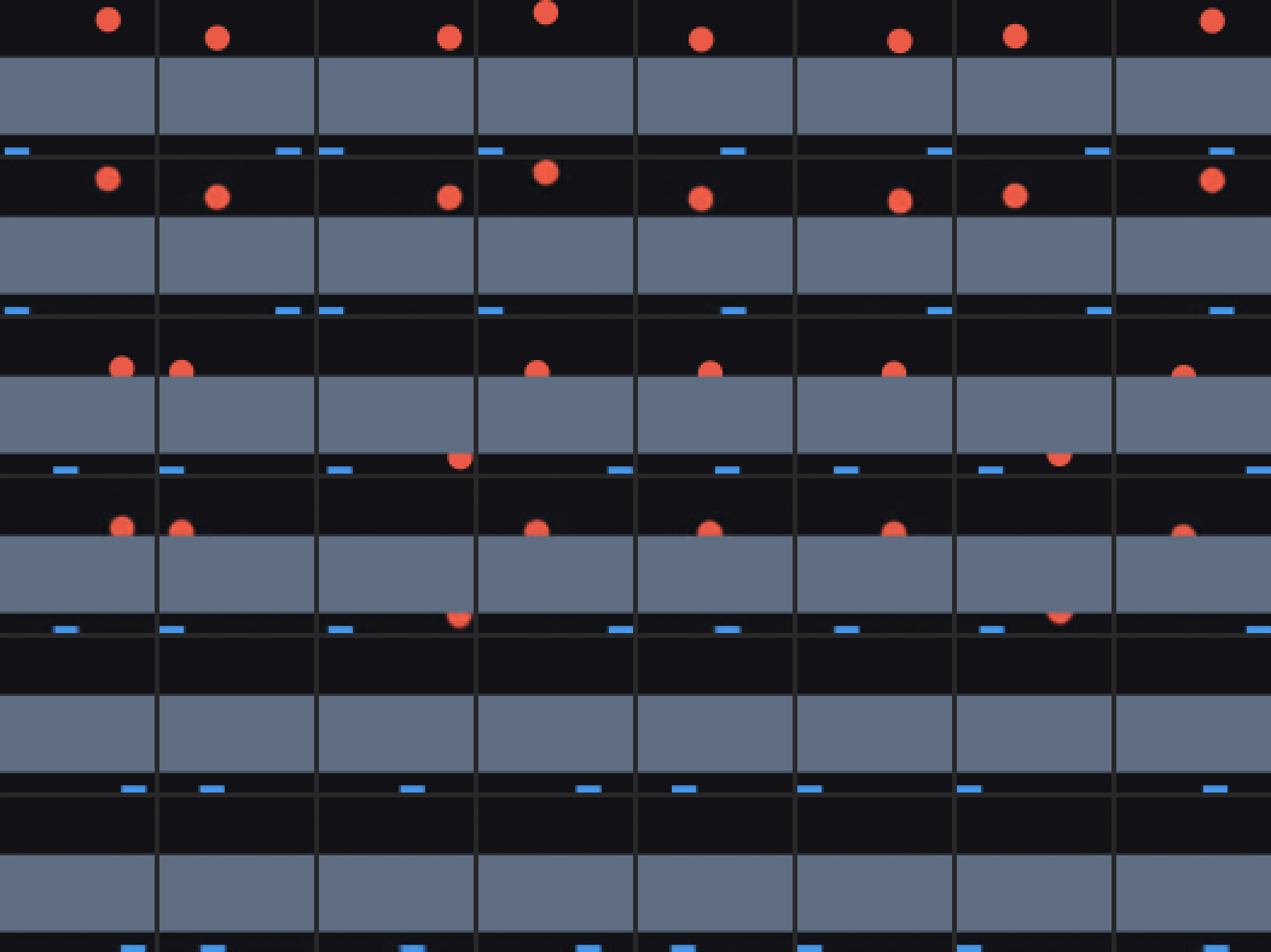
runs/v31_env/occlusion_episode.gif is one crossing with a wall bounce behind
the band: the ball enters at y = 0.20 (just above the paddle), is hidden for 25
frames, bounces off a side wall out of sight, and comes back out of the top at
x = 0.60 having gone in at x = 0.83.
3. The VAE
Same hyper-parameters as v3 (z_dim 16, free-bits 0.5, β warm-up 5, 60 epochs), four training roots instead of one: 130,650 frames per epoch against v3’s 30,150, which is the whole of the 110-minute wall clock (110 s/epoch against v3’s 29 s).
v1 (vae_b1, 80 ep) |
v2 (vae_v2, 60 ep) |
v3 (vae_v3, 60 ep) |
v3.1 (vae_v31, 60 ep) |
|
|---|---|---|---|---|
| final KL (nats) | 14.38 | 15.45 | 11.87 | 11.32 |
| global MSE | 0.00036 | 0.00043 | 0.00031 | 0.00020 |
| ball MSE | 0.00424 | 0.00534 | 0.00317 | 0.00173 |
active units (on probe) |
9 | 8 | 6 | 5 |
Both loss columns improving again is the same effect v3 saw and not a better VAE: 42% of frames now have no ball in them at all and are nearly trivial to reconstruct. The KL falling a further half-nat while the model is asked to additionally encode which of three bands it is looking at is the interesting part — see §3.3.
No instability: the loss falls monotonically from the end of β warm-up (epoch 6) to 59 and the last five epochs move it by 0.03 nats.
3.1 Probes conditioned on visibility, on all three bands
Episode-level splits within each bin. rmse is in world units (the box is 1.0
across) and is the column to read across bins; R² is scored against the variance
of whatever slice you conditioned on, and these slices have wildly different
spreads (README_V3.md §5.3).
Default band, data/v31/probe (720 visible / 1013 partial / 1267 hidden):
bin       frames  eps    linear.x       poly2.x         knn.x      linear.y       poly2.y         knn.y
visible      720   58  0.899/0.053   0.989/0.017   0.981/0.023   0.937/0.015   0.856/0.023   0.892/0.020
partial     1013  108  0.598/0.131   0.723/0.108   0.578/0.134   0.691/0.122   0.852/0.085   0.789/0.101
hidden      1267   96 -0.070/0.267  -0.100/0.271  -0.005/0.259  -0.010/0.098  -0.154/0.105  -0.107/0.102
Short band, data/v31/short (0.13–0.45):
visible     2763   30  0.686/0.142   0.996/0.016   0.996/0.017   0.793/0.052   0.981/0.016   0.981/0.016
partial     1922   30  0.695/0.136   0.839/0.098   0.848/0.096   0.802/0.066   0.936/0.038   0.917/0.043
hidden      1345   30  0.191/0.220   0.162/0.224   0.110/0.231  -0.031/0.051  -0.089/0.053  -0.070/0.052
Long band, data/v31/long (0.13–0.78):
visible      377   27  0.976/0.043   0.995/0.020   0.995/0.019   0.807/0.008  -1.119/0.028   0.604/0.012
partial     1793   30  0.700/0.132   0.789/0.111   0.766/0.117   0.781/0.146   0.901/0.098   0.870/0.112
hidden      3860   30 -0.022/0.239  -0.145/0.253  -0.678/0.306  -0.002/0.142  -0.040/0.145  -0.091/0.148
Positions decode equally well on all three bands. Visible-bin x rmse is 0.017 / 0.016 / 0.020 world units across default / short / long — a 25% spread, against v3’s 133–262× reconstruction gap between its trained band and the other two. Whatever a taller band costs the pipeline downstream, it is no longer the encoder.
Two honest wrinkles, both about which slice you are in rather than about the encoder:
- The hidden bin on
shortis R² +0.19 in x, not ≤ 0. This is the paddle leak, measured:shortwas collected with the tracking policy, so the (always-visible) paddle sits roughly under the ball, and a probe can read some ball x off it.probeandvalare sticky-policy and come out at ≤ 0. It is not a band effect and not an encoder fault — it is the same leakREADME_M3.mdflags, and it is precisely why stage two’s floor is the feed-forward model and not zero. - The long band’s visible bin has only 377 frames in 27 episodes and its ball_y there is confined to a 0.22-wide strip above y = 0.78 (test-split sd 0.028), which is why poly-2 scores −1.12 on a 0.028 rmse. Read the rmse.
3.2 Hallucination: still no ball painted where there is none
| band | spurious ball mass on hidden frames | on visible frames | brightest hidden pixel |
|---|---|---|---|
| 0.13–0.63 | 0.031 balls | 1.033 | 0.089 (median 0.062) |
| 0.13–0.45 | 0.044 | 1.051 | 0.091 (median 0.062) |
| 0.13–0.78 | 0.034 | 1.033 | 0.091 (median 0.062) |
v3 was 0.024 balls with a 0.095 peak. The peak is what matters: 0.09 means the
residual is diffuse decoder haze spread over hundreds of pixels, not a ball
drawn in the wrong place. recon_by_visibility.png says the same by eye on all
three bands — partial balls come back as slivers on the correct band edge at
the correct x, hidden frames come back empty.
3.3 The band’s height: a nuisance factor, carried for free
New in v3.1, and the question the design raised: the top edge takes three values across the training data, so the encoder has to represent it or eat the reconstruction cost.
| encoder | R² (linear / poly2 / kNN) | nearest-of-three accuracy | majority class |
|---|---|---|---|
vae_v31 (trained on all three) |
0.949 / 0.997 / 0.937 | 0.999 / 1.000 | 0.367 |
vae_v3 (trained on one band) |
−0.250 / −0.071 / −0.119 | 0.579 / 0.615 | 0.592 |
The v3 encoder cannot tell the bands apart at all — accuracy at the majority class — which is the same fact as its 262× reconstruction blow-up, seen from the latent side. The v3.1 encoder is perfect on it.
And it costs nothing measurable. Active units are 5/16 on probe (v3: 6/16),
7/16 on short, 4/16 on long; total KL fell 0.55 nats. The band is a
constant within an episode and occupies a contiguous block of rows, so one
low-KL direction covers it — z[14], whose tuning map is a near-uniform slab
and which is also the best single dimension for ball_visible (poly-2 0.296,
against 0.086 for v3’s best). Position is unaffected: visible-bin x is 0.989
against v3’s 0.984.
The tuning maps show the geometry directly:
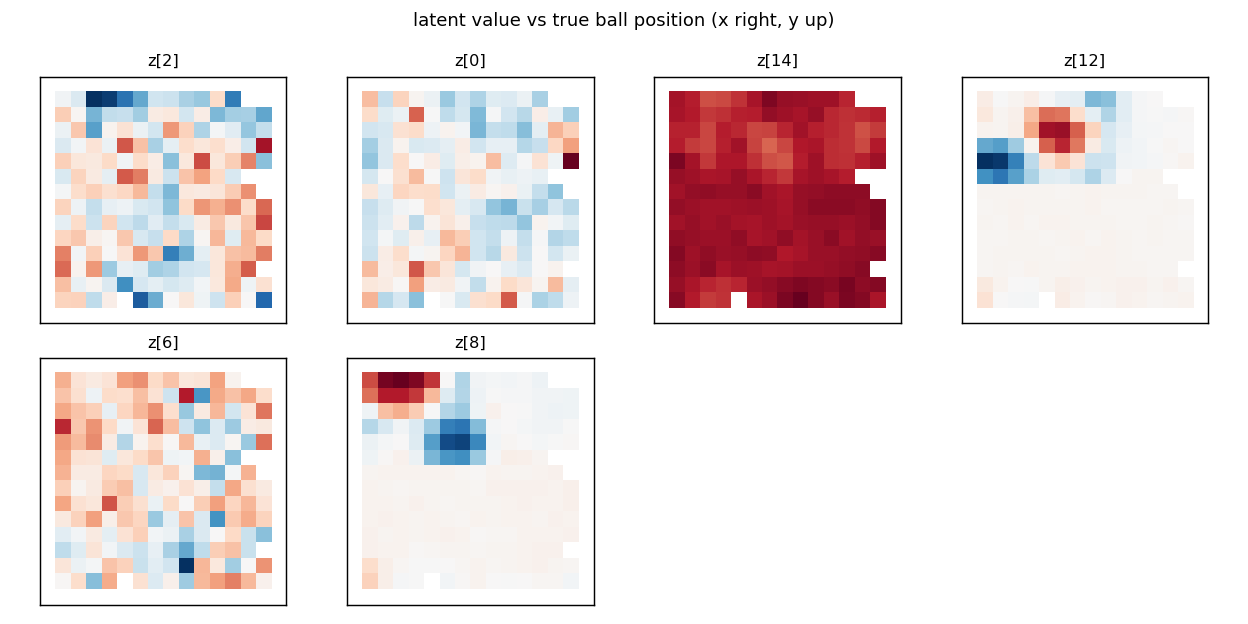
v3’s maps had a pale horizontal stripe across the middle where the band was.
v3.1’s are flat over the whole lower two-thirds — the ball is hidden or
partial everywhere below y ≈ 0.63 — with the place fields (z[12], z[8])
packed into the visible strip above it. The occlusion is visible in the latent
geometry, and v3.1’s occlusion is most of the box.
ball_visible from the whole of mu is 0.988 (poly-2), essentially v3’s 0.984,
and still not axis-aligned: best single dimension 0.296.
4. Stage two — the dynamics models
4.0 What is privileged, and how much
Unchanged from README_FIX3.md §1, and worth repeating
because the whole argument rests on it:
rnn_v31is the fair model. Self-supervised on cached latents and actions; nothing privileged anywhere.rnn_v31_ffreplaces the LSTM with a two-layer MLP on[z_t, a_t]. It cannot carry anything through the gap, by construction. It is the floor, and the gap up from it is the part that is memory.rnn_v31_posheadtrains a linear head onhpredicting the simulator’s true(ball_x, ball_y)on every frame, hidden ones included. This is a PRIVILEGED CEILING, not a world-model result — it is a direct instruction about what to remember. Nothing downstream reads the head; every evaluation reads position out ofhwith its own external probe.rnn_v31_emergeup-weights the MDN NLL ×5 on frames where the ball has just re-emerged, plus a 24-step open-loop rollout loss. The weighting uses the privilegedball_visibleflag to decide how much a transition counts — weak, but not zero.
Why K = 24 and not 32. v3.1’s hidden runs have median 19 and mean 21.6
frames, and K = 24 reaches the exit frame for 72% of them (K = 32 would
reach 89%). Raising K to 32 would also have meant raising --seq-len past 32 —
rollout_losses samples its start inside the window — which would have changed
the window the baseline sees and broken the only comparison that matters. So
K stayed at v3’s value and the 28% of runs it cannot span are declared here.
4.1 Training
| model | params | wall clock | best val NLL | best val hit F1 | open-loop latent MSE @ h=32 |
|---|---|---|---|---|---|
rnn_v31 (fair) |
327k | 1237 s | 5.292 | 0.502 | 0.304 |
rnn_v31_ff (floor) |
114k | 504 s | 6.896 | 0.376 | 0.777 |
rnn_v31_poshead (ceiling, privileged) |
327k | 1274 s | 5.335 | 0.507 | 0.299 |
rnn_v31_emerge (fair fix) |
327k | 1861 s | 6.123 | 0.421 | 0.316 |
rnn_v31_allbands (fair, 4 roots) |
327k | 624 s (solo) | 5.207 | 0.508 | 0.286 |
Selection is best-teacher-forced-val-NLL, unchanged since v1. emerge’s NLL is
worse because it is optimising something the selection rule cannot see (that is
why rnn_last.pt is saved alongside). Train and val NLL are not comparable
to each other — train targets are posterior samples, val targets posterior
means — only across runs.
4.2 The standard evaluations (wm.eval_rnn)
| baseline | ff (floor) | poshead (ceiling) | emerge | |
|---|---|---|---|---|
| useful dream horizon, visible frames, τ=0 | 16 | 4 | 17 | 16 |
| ball error at h=16 (visible frames) | 0.038 | 0.243 | 0.035 | 0.048 |
ball_vx from h, linear R² |
0.463 | −0.007 | 0.506 | 0.383 |
ball_vy from h, linear R² |
0.343 | −0.302 | 0.371 | 0.408 |
| paddle separation, 30 steps left vs right | 0.792 | 0.642 | 0.773 | 0.802 |
| paddle-contact PR-AUC (base rate 0.76%) | 0.551 | 0.440 | 0.611 | 0.530 |
Two things to note against v3. The visible-frame dream horizon went up
(14 → 16) even though 42% of frames now carry no ball, and the feed-forward
floor collapsed further (v3’s ff was not run on this metric; here it is 4).
But velocity out of h got much worse: v3’s baseline read ball_vy at
linear R² 0.838 and v3.1’s at 0.343. That is the price of the geometry — the
ball is visible on 24% of frames instead of 44%, so there are far fewer
consecutive sightings to integrate a velocity from.
4.3 (a) Position from h while the ball is hidden — the headline
Frozen probe, episode-level split, 3135 fully hidden frames. R² / rmse in world
units; the hidden bin’s ball_x spread is ~0.24, so read rmse across bins.
| feature | hidden ball_x (linear) |
hidden ball_x (kNN) |
hidden ball_y (linear) |
|---|---|---|---|
z (the frame alone) |
0.11 / 0.222 | −0.26 / 0.265 | −0.02 / 0.102 |
h[baseline] |
0.52 / 0.163 | 0.50 / 0.167 | 0.09 / 0.096 |
h[ff] (floor) |
0.01 / 0.235 | −0.21 / 0.260 | −0.08 / 0.105 |
h[poshead] (ceiling) |
0.48 / 0.170 | 0.49 / 0.169 | 0.09 / 0.096 |
h[emerge] |
0.35 / 0.191 | 0.24 / 0.206 | 0.15 / 0.093 |
This is the result v3 could not get. Against v3’s same table — baseline 0.17, ff −0.21, poshead 0.71, emerge 0.44 — the fair model went from 0.17 to 0.52 and the gap to the privileged ceiling closed to nothing (0.52 vs 0.48; the ordering even reverses, within noise). In v3 the fair model recovered 0.38 of the ff→poshead span; in v3.1 it recovers all of it.
The reason is the one the design predicted for the opposite outcome: longer occlusions and more hidden bounces mean more training signal per crossing. 21 frames of hidden ball per traverse, and a wall bounce in 36% of them, makes “where is the ball now” a question the one-step likelihood eventually pays for.
ball_y is the mirror image: 0.09 for everything that has memory, because
v3.1’s band is 0.50 tall and the y spread inside it is small (rmse 0.096
against a 0.10 spread), so there is almost nothing for R² to explain. v3’s
y numbers (0.51) were scored on a 0.30-tall band. Read the rmse.
The decay curve — one frozen probe, scored at each hidden age, pooled over all three bands:
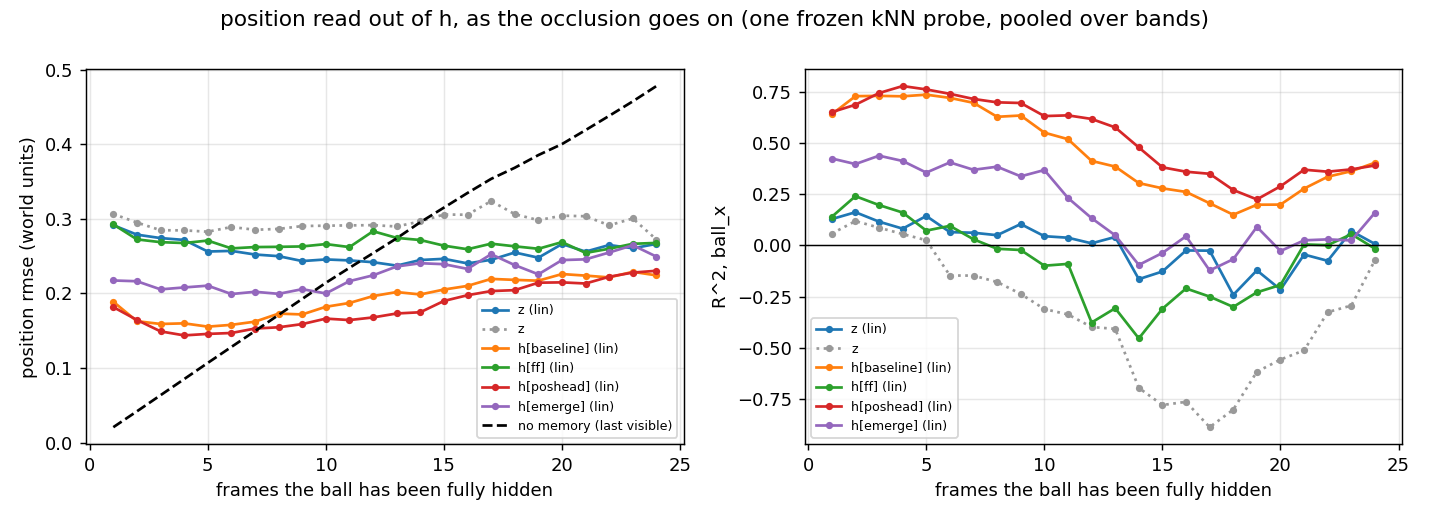
ball_x rmse (world units) against the no-memory baseline (“the ball is where
it vanished”):
| k (frames hidden) | 1 | 4 | 8 | 11 | 14 | 17 | 20 | 24 |
|---|---|---|---|---|---|---|---|---|
| no memory | 0.015 | 0.059 | 0.121 | 0.163 | 0.203 | 0.243 | 0.281 | 0.345 |
h[baseline] |
0.148 | 0.125 | 0.142 | 0.160 | 0.178 | 0.196 | 0.197 | 0.173 |
h[poshead] (ceiling) |
0.146 | 0.113 | 0.128 | 0.139 | 0.154 | 0.178 | 0.185 | 0.175 |
h[emerge] |
0.187 | 0.185 | 0.182 | 0.202 | 0.223 | 0.221 | 0.223 | 0.206 |
h[ff] (floor) |
0.229 | 0.221 | 0.234 | 0.241 | 0.257 | 0.246 | 0.240 | 0.226 |
z |
0.230 | 0.231 | 0.227 | 0.226 | 0.230 | 0.223 | 0.242 | 0.224 |
Memory-horizon crossover (the k at which h beats “do nothing” on ball_x)
| v3 | v3.1 | |
|---|---|---|
| baseline | ~13 | 11 |
| poshead (ceiling) | — | 9 |
| emerge | — | 16 |
| ff (floor) | — | 18 |
z |
— | 16 |
and the crossover is now below the default band’s mean occlusion (21
frames), where in v3 it was above it (13 vs 9.4). That inversion is the single
sentence answer to the question the brief asks: the longer default occlusion
made the fair model’s horizontal permanence better, not worse. At k = 24
the baseline still reads ball_x at R² 0.404 while the no-memory baseline
is at −1.358.
The curve stops at k = 24 despite --max-age 40: past that, no single k has the
25 held-out frames the per-bin fit requires, because the long tail is spread
thinly over many distinct k.
4.4 (f) What else is in h on hidden frames
| feature | ball_vx |
ball_vy |
frames hidden |
|---|---|---|---|
z |
−0.005 | −0.183 | −0.577 |
h[baseline] |
0.005 | −0.324 | −0.232 |
h[ff] |
−0.088 | −0.291 | −1.194 |
h[poshead] (ceiling) |
0.190 | −0.002 | −0.706 |
h[emerge] |
−0.021 | 0.159 | −0.304 |
This is a clean regression from v3 and the most surprising result in v3.1.
v3’s baseline carried ball_vy at R² 0.67 and “how long have I been hidden” at
0.54 — a clock and a falling ball. v3.1’s carries neither: −0.32 and −0.23.
The model now knows where the ball is and no longer knows when it will come
back, which is exactly the opposite of v3’s split. §4.9 argues why.
4.5 (b) Emergence — the experiment lost its instrument
The dream never brings the ball back, so (b) has no power on the default
band. Of 99 hidden runs in val + val_mix:
| model | runs scored (of 99) | censored |
|---|---|---|
| baseline | 5 | 0.95 |
| ff | 0 | 1.00 |
| poshead | 2 | 0.98 |
| emerge | 2 | 0.98 |
This is not a code fault and not a threshold to be tuned away — it is geometric, and it is worth stating precisely because it will bite anyone re-running this suite on a tall band. The exit detector calls an exit when the decoded ball leaves the band interior for two consecutive frames. An open-loop dream with no ball information in it converges to the “blank band” latent, which decodes to y = 0.384 — the middle of v3.1’s band. v3’s band interior was 0.36–0.50, a 0.14-wide strip that dream noise alone pushed a prediction out of; v3.1’s is 0.21–0.55, and a collapsed dream sits inside it for ever. The picture is unambiguous:
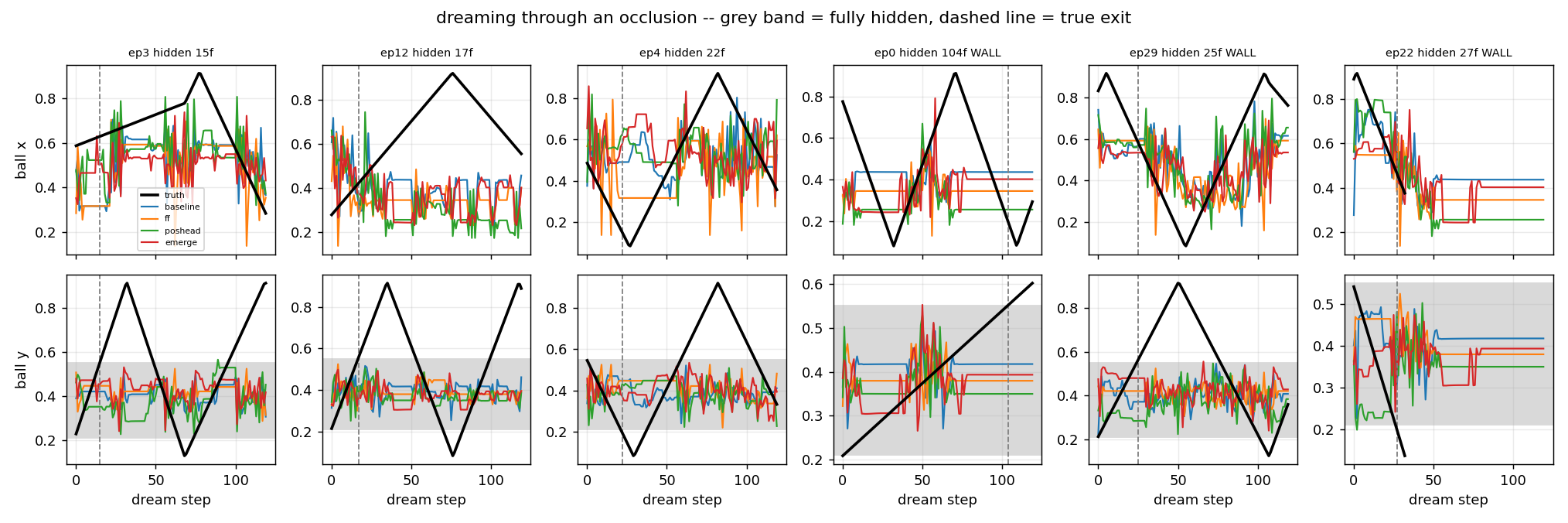
Bottom row, every panel: the dreamed ball_y flattens to ≈0.40 inside the grey
band within about ten steps and stays there, while the truth (black) completes
two whole traverses. So the exit-x / exit-time / side columns for v3.1 are
computed on 0–5 runs and must not be quoted. The 0.164 exit-x MAE in the
figure’s table is five runs.
runs/rnn_v31_permanence/exit_x_pred_vs_true.png says it in one glance: the
no_memory panel has 99 points, the four model panels have 5, 0, 2 and 2.
exit_time_error_hist.png carries the same n in its legend.
That is the honest headline for (b): h holds the hidden ball’s x (§4.3) and
the decoder path does not express it. v3 found a weaker version of the same
thing (emerge doubled hidden-x information in h without improving the
dream’s exit); v3.1’s longer occlusion turns the same defect from a degradation
into a total loss.
4.6 (c) Hidden wall bounces — the one dream-side win
Pooled over all three bands, 102 hidden runs containing a side-wall bounce the camera never saw (v3’s default band had 12; v3.1’s has 35 on the default band alone). “Nearer reflected” asks whether the prediction is closer to the truth (the ball bounced) or to the straight line clipped at the wall (it kept going). Chance is 0.50; the straight-line baseline is 0.00 by construction.
| model | n scored | nearer reflected | on clear overshoots (n) |
|---|---|---|---|
| baseline | 23 | 1.00 | 1.00 (19) |
| ff (floor) | 22 | 0.95 | 0.94 (18) |
| poshead (ceiling) | 22 | 1.00 | 1.00 (18) |
| emerge | 27 | 0.96 | 0.95 (22) |
| no memory | 102 | 0.67 | 0.64 (91) |
| linear (straight line) | 102 | 0.00 | 0.00 (91) |
v3 got 0.88 against a 0.69 no-memory; v3.1 gets 1.00 against 0.67. But the feed-forward floor also scores 0.95, which it could not possibly do by remembering anything — so this metric is mostly measuring “does the prediction end up somewhere central rather than pinned against a wall”, not “did the model simulate the bounce”. v3’s 0.88-vs-0.69 gap was already weak evidence; v3.1’s ff control shows why. Do not quote this as permanence.
4.7 (d) Memory horizon on the dream, and (e) the counterfactual
Exit-x MAE pooled over bands, by true hidden duration. n_scored is how many
runs the model brought a ball back for at all, and it is the column to read:
| model | 3–8 | 9–15 | 16–25 | 26+ |
|---|---|---|---|---|
| baseline | 0.183 | 0.174 | 0.221 | 0.170 |
| poshead (ceiling) | 0.194 | 0.196 | 0.249 | 0.118 |
| emerge | 0.181 | 0.167 | 0.268 | 0.260 |
| ff (floor) | 0.217 | 0.200 | 0.257 | 0.206 |
| no memory | 0.056 | 0.155 | 0.195 | 0.350 |
| n runs | 23 | 48 | 126 | 75 |
| baseline n_scored | 23 | 47 | 18 | 4 |
The 3–8 and 9–15 bins are entirely short-band runs (the default band admits no
hidden run shorter than 15 frames — the shortest in val + val_mix is 15), and
they are the only bins where the dream survives. Past 16 frames the model
re-emerges a ball on 14% of runs and past 26 on 5%, so the apparent win at 26+
(0.170 vs 0.350) is four runs. No crossover can be claimed from the dream;
the crossover in §4.3 is measured on h directly and is the one to use.
(e) The counterfactual (vx → −vx before entry, re-simulated, re-encoded,
re-dreamed) survives on 34 runs and says the same thing twice: the sign of
the dreamed horizontal displacement agrees with the physics on 100% of runs
for baseline / poshead / emerge and 0% for ff — but the magnitude is
−0.018 against a true −0.196, i.e. an order of magnitude too small. The
model knows which way, not how far. (v3 got the sign right 55% of the time, so
this is a genuine improvement in kind.)
4.8 Conservation (wm.eval_conservation) — still bad, still a stage-three blocker
Does the hidden ball keep its vertical direction of travel across a dreamed occlusion? Nothing inside the band can turn a ball around, so the answer must be 1.0. Instrument floor (the same estimator on TRUE latents): 0.975 on 79 stretches.
| model | τ=0 (n) | τ=0.5 (n) | τ=1.0 (n) |
|---|---|---|---|
| baseline | 1.000 (6) | 0.492 (325) | 0.472 (218) |
| ff (floor) | — (0) | 0.385 (13) | 0.286 (14) |
| poshead (ceiling) | 0.556 (9) | 0.560 (91) | 0.618 (34) |
| emerge | 0.419 (31) | 0.420 (569) | 0.400 (50) |
The comparison figure’s table shows baseline “vy kept 1.00” and that number is six stretches — the same censoring as §4.5, because a dream that never leaves the band has no complete hidden stretch to score. The numbers with sample size behind them are the τ = 0.5 and τ = 1.0 columns, and they are coin flips: 0.49 and 0.47, against v3’s 0.60 and 0.50. Verdict unchanged and stronger: do not train a controller in a sampled v3.1 dream.
4.9 Surprises
1. The fair model matched the privileged ceiling. 0.52 vs 0.48 hidden-x
R², where v3 was 0.17 vs 0.71. The environment change did what four different
loss functions in README_FIX3.md could not. The lesson generalises past this
project: when a self-supervised objective will not learn a variable, the first
thing to check is whether the data ever makes that variable pay, not whether
the loss can be reweighted into caring.
2. emerge is now actively harmful. It was v3’s best fair fix (0.44 vs a
0.17 baseline); on v3.1 it is 0.35 against a 0.52 baseline, its crossover is 5
frames later, and its val NLL is 0.8 nats worse. The fix was compensating for a
signal shortage that no longer exists, and the 24-step rollout term it carries
now costs teacher-forced accuracy for nothing.
3. Vertical permanence went backwards while horizontal went forwards. v3:
ball_vy from h 0.67, hidden-frame count 0.54, hidden-x 0.17. v3.1:
−0.32, −0.23, 0.52. The trade is legible: v3’s band was crossed in 9 frames
with the ball visible 44% of the time, so the cheap win was a clock; v3.1’s is
crossed in 21 frames with the ball visible 24% of the time, so a clock is both
harder to run and less useful than a position estimate, and 256 units went where
the likelihood paid.
4. The exit-based instrument does not survive a tall band. §4.5. Four of the
six experiments in eval_permanence_v3 depend on detecting a decoded ball
leaving the band, and that detector’s power is a function of how narrow the
band interior is. This is a methodological finding, not a result, and anyone
re-using the suite needs it.
5. The VAE carried a three-valued nuisance factor for free (§3.3) — 1.000 classification accuracy, 0.55 nats less KL than v3. I expected the band top to cost positional precision; it cost nothing measurable.
4.10 Honest failures
- (b), (d) and the τ=0 conservation column have no sample on the default
band. 5, 4 and 6 runs respectively. The exit-x MAE, exit-time MAE, side-
correct and “vy kept at τ=0” columns of
runs/rnn_v31_permanence_comparison.mdare printed because the script prints them; they are not evidence. - (c) is confounded by the feed-forward control scoring 0.95. §4.6.
ball_yR² on hidden frames is ~0.09 for every model with memory, and that is a variance artefact of a 0.50-tall band, not a finding. The rmse (0.096 against a 0.10 spread) is the honest number and it says almost nothing is being tracked vertically.- The
shortsplit’s hidden bin leaks ball x through the paddle (§3.1, R² +0.19). Every claim in §4.3 is therefore stated againsth[ff], which has the identical access to that cue, and never against zero. --max-age 40did not buy 40 frames of curve; the per-k sample threshold cut it at 24. To see further, thelongsplit needs more than 30 episodes.- Band diversity in the dynamics training data does not help.
rnn_v31_allbands(all four training roots) gets hidden-xR² 0.34 linear / 0.50 kNN against the two-root baseline’s 0.52 / 0.50, and hidden-y0.23 against 0.09. So it trades a little x for a little y and is not the better model; the extra bands help the encoder (§3) and not the dynamics.
4.11 The comparison figure
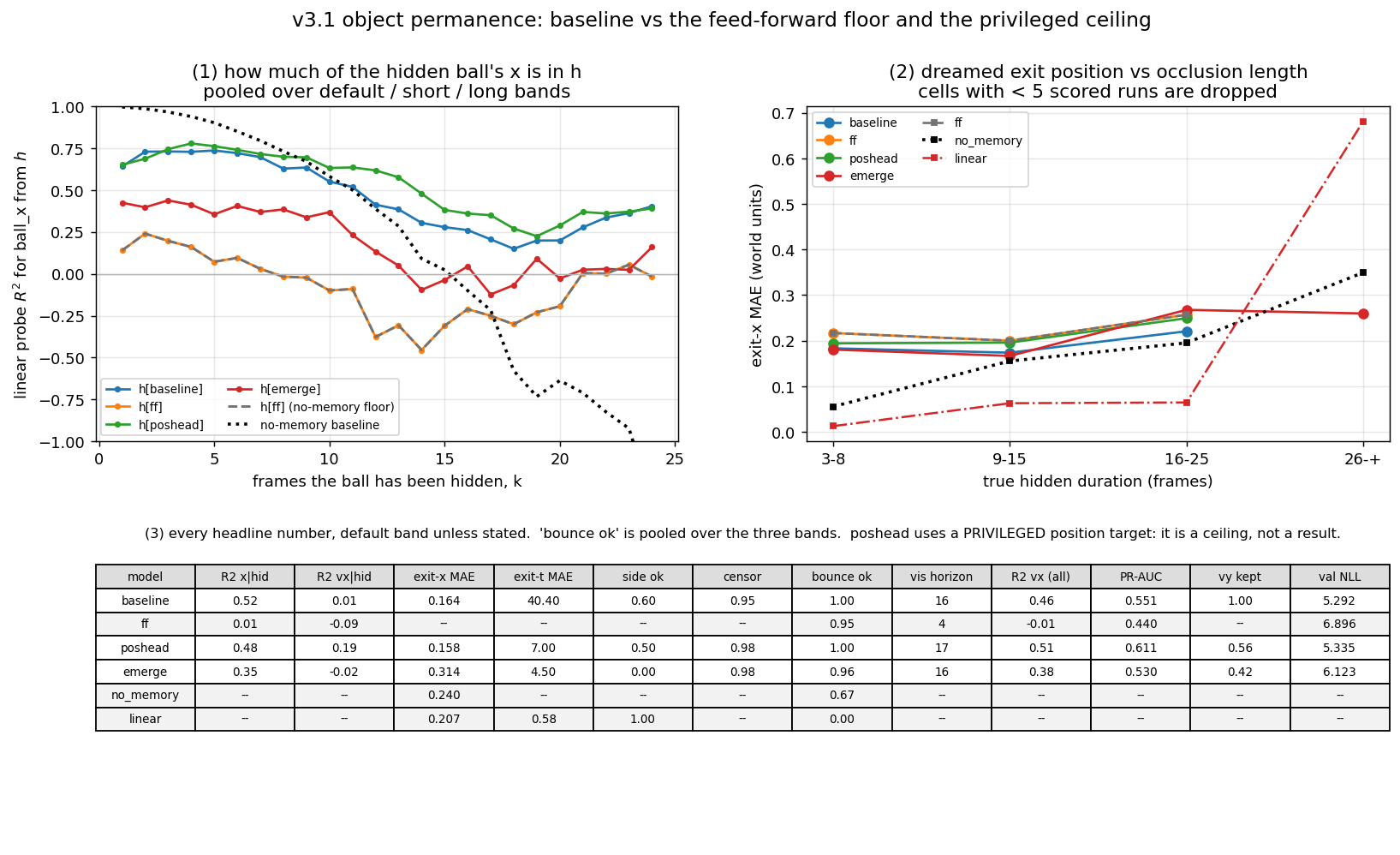
Panel (1) is the result: h[baseline] (orange) and h[poshead] (red, the
privileged ceiling) on top of each other at R² 0.65–0.78 for the first ten
hidden frames and still at 0.3–0.4 at k = 24, while the no-memory baseline
(dotted black) crosses zero at k ≈ 15 and falls to −1, and h[ff] (green, the
floor) never leaves the ±0.25 band. Panel (2) is the censored one — read §4.5
before reading it. Panel (3) is every headline number; the columns to trust are
R2 x|hid, R2 vx|hid, bounce ok, vis horizon, R2 vx (all), PR-AUC and
val NLL.
runs/rnn_v31_permanence_comparison.md and .json carry the same table.
5. What stage three inherits
| encoder | runs/vae_v31/vae.pt (z_dim 16, 5 active units, trained on all three bands) |
| dynamics model | runs/rnn_v31/rnn.pt — the fair baseline. It is the best model on val NLL among the fair runs (5.292), the best on hidden-x memory (0.52), and the only one with no privileged term anywhere. rnn_v31_poshead must not be used: its position head makes every controller result unpublishable |
| latents | cached for all nine splits as mu.npy / logvar.npy in each data/v31/* |
The exact real environment, which wm.eval_controller / wm.train_controller
must be given explicitly (the BoxConfig defaults are still v1’s):
BoxConfig(res=64, ball_radius=0.08, occluder=True,
          occluder_y=(0.13, 0.63), paddle_w=0.16)
--ball-radius 0.08 --occluder --occluder-y 0.13 0.63 --paddle-w 0.16
--paddle-w is new and is not optional: the paddle’s width sets the chance
catch rate, so a controller evaluated at 0.26 in a world trained at 0.16 is
being scored against the wrong floor. build_baselines(paddle_w) now takes it
too, so the oracle’s dead zone matches the world it plays in.
The three numbers stage three is graded against, from
runs/v31_design/sweep.md:
| reference policy | interceptions per floor visit |
|---|---|
| full oracle (tracks the true ball always) | 0.99 |
| wait-and-see oracle (the memoryless bound) | 0.48 |
| stand still | 0.38 |
A fair controller above 0.48 is using memory. And one caution from stage two that is now established twice over: §4.8 says the sampled dream does not conserve the hidden ball’s direction of travel (0.47–0.49 against a 0.975 instrument floor), so a controller trained inside a τ > 0 dream is training against a coin flip. Train on real rollouts, or at τ = 0 with the §4.5 caveat that the τ = 0 dream does not bring the ball out of the band at all.